Schnell ausgebucht20 % Rabatt
Kategorien in Lissabon
Die Beschreibungen werden auf Englisch angezeigt.
Die Beschreibungen stammen vom Anbieter und werden automatisch übersetzt.
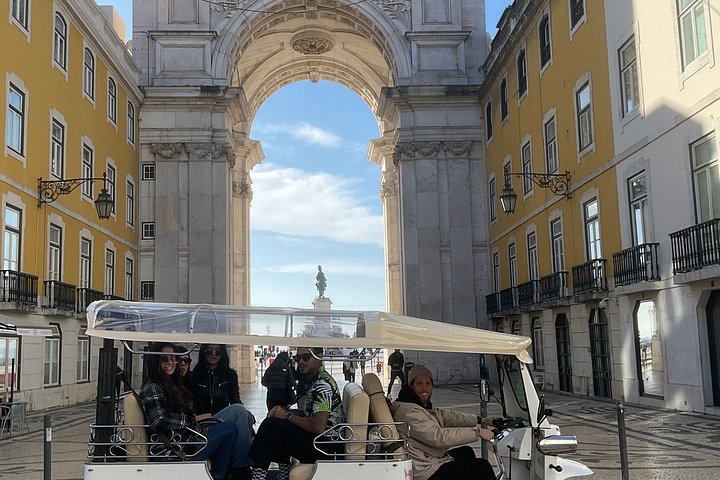
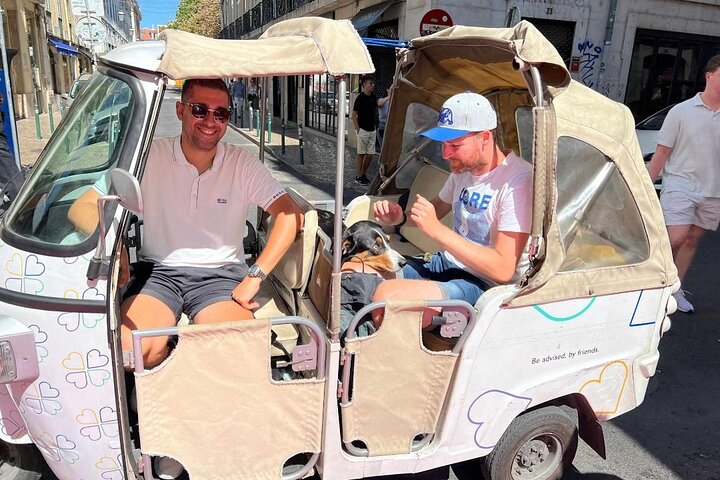
* The best and most interesting way DE to know some of the most beautiful historical and cultural monuments DA cida DE Lisboa, as well as the iconic neighborhoods typical OF the city. * All our services are private, you will travel only with your family, friends, or coworkers. Our professional drivers will be your personal assistants throughout the ride, taking care DE that everything is at your pleasure. * You will travel in luxury vehicles, with all the safety and comfort necessary to make your ride unforgettable. * This is our commitment to know one of the most beautiful European capitals "LISBOA".
Welcome customers. Departure from the Hotel, Private Accommodation or the agreed meeting point.
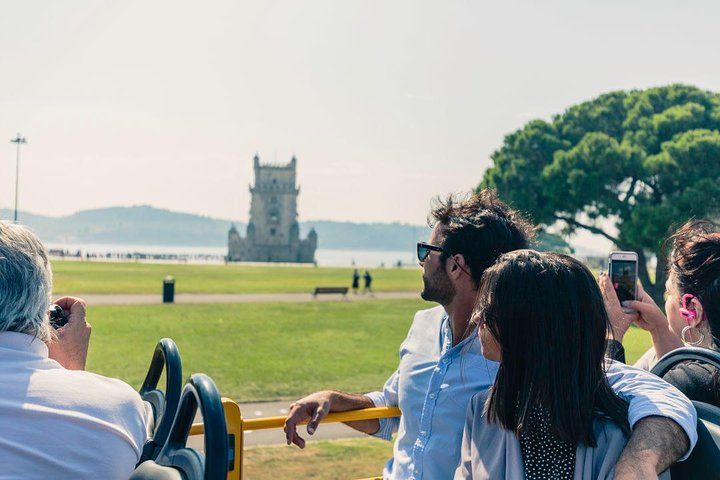
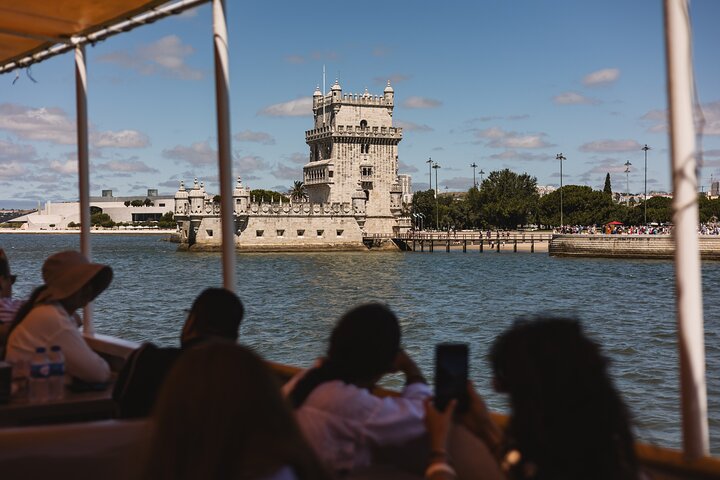
The Torre de Belém, formerly Torre de São Vicente, is a fortification located in Belém, on the right bank of the Tagus River, where Belém beach once existed, it was originally surrounded by water along its entire perimeter. Over the centuries it was surrounded by the beach, until today it became part of dry land. One of the city's ex libris, the monument is an architectural icon of the reign of D. Manuel I. Over time, the tower lost its function of defending the Tagus River and, following the Philippine occupation, the old warehouses gave way to dungeons. On the four floors of the tower, the Governor's Room, the Kings Room, the Audience Room and, finally, the Chapel with its characteristic 16th century vaults remain. The Tower of São Vicente (1514) belongs to a formation defending the Tagus basin ordered to be erected by João II of Portugal, composed to the south by the tower of São Sebastião da Caparica (1481) and to the west by the Tower of Santo António de Cascais ( 1488).
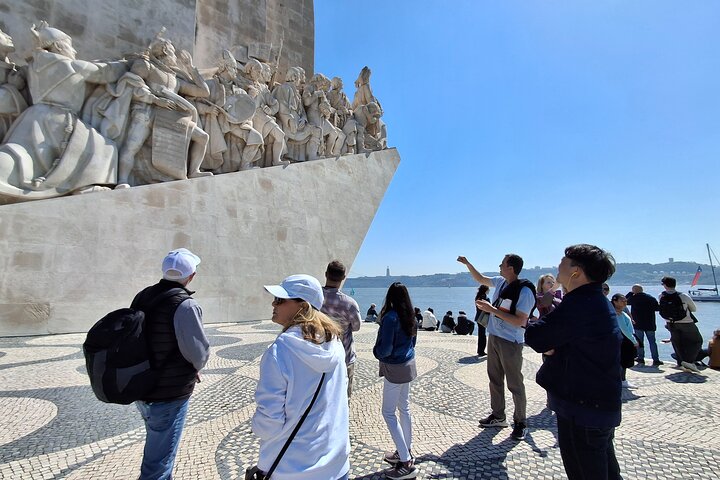
Designed by architect Cottinelli Telmo and sculptor Leopoldo de Almeida, this monument rises more than 50 meters high in front of the Tagus River. Built for the first time in 1940, part of the Portuguese World Exhibition, one of the largest exhibitions organized in Portugal to date. Originally built from perishable materials, it was rebuilt in 1960, on the occasion of the 500th anniversary of the death of Infante D. Henrique – a great driver of the Portuguese Discoveries. Taking the shape of a stylized caravel that sets out to sea, it takes the Infante to the bow, followed by some protagonists of overseas prowess and culture of the time portrayed with symbols that individualize them, namely, navigators, cartographers, warriors, colonizers, evangelizers, chroniclers and artists. In the yard leading to the monument, the Compass Rose immediately stands out, inaugurated on August 5, 1960, designed in the architect's studio. Luís Cristino Silva and offered by the Rep. of South Africa.
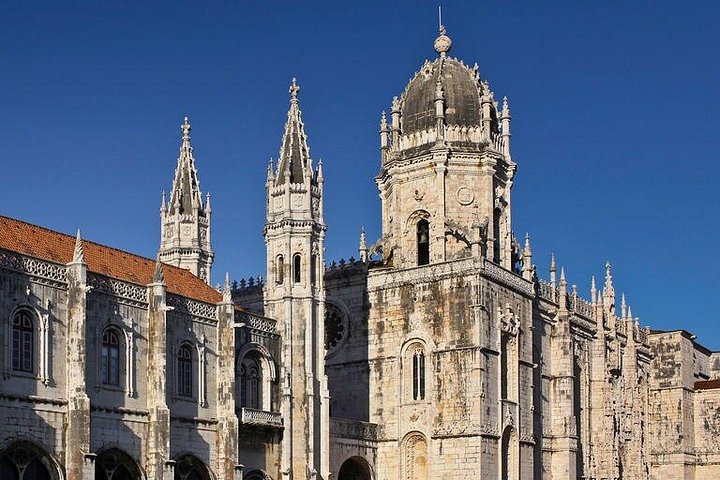
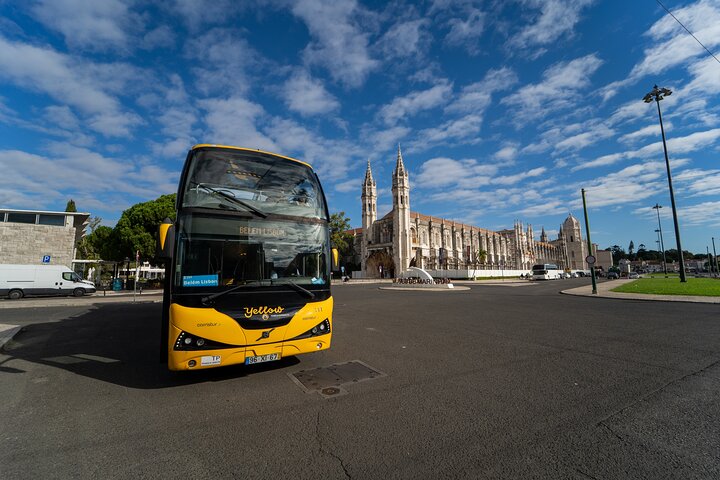
The request made by King D. Manuel to the Holy See dates back to 1496, asking for authorization to build a large monastery at the entrance to Lisbon, close to the banks of the Tagus. In 1501 work began and, approximately a century later, the works were completed. The Jerónimos Monastery is usually considered the "jewel" of the Manueline style. This exclusively Portuguese style integrates architectural elements from the late Gothic and Renaissance, associating it with a Christological and naturalistic royal symbolism, which makes it unique and worthy of admiration. To occupy the Monastery, D. Manuel chose the monks of the Order of S. Jerónimo, whose functions, among others, would be to pray for the king's soul and provide spiritual assistance to sailors and navigators who left Restelo beach to discover other worlds. . Today it is reviewed by each of us not only as a remarkable piece of architecture but as an integral part of our culture and identity.
Pastel de nata is a popular Portuguese sweets specialty, inspired by convents. It was created by monks at the Jerónimos Monastery and has certified origin. The original recipe is called Pastel de Belém, produced exclusively at the Fábrica dos Pastéis de Belém, in Lisbon. In 1837, in Belém, close to the Jerónimos Monastery, in an attempt to make a living, the clergy of the monastery offered some custard tarts for sale. At that time, Belém and Lisbon were two distinct locations with access by steamboats. The presence of the Jerónimos Monastery and the Belém Tower attracted numerous tourists who contributed to spreading the Belém pastries. Feel invited to try a pastel de Belém + a coffee (espresso)
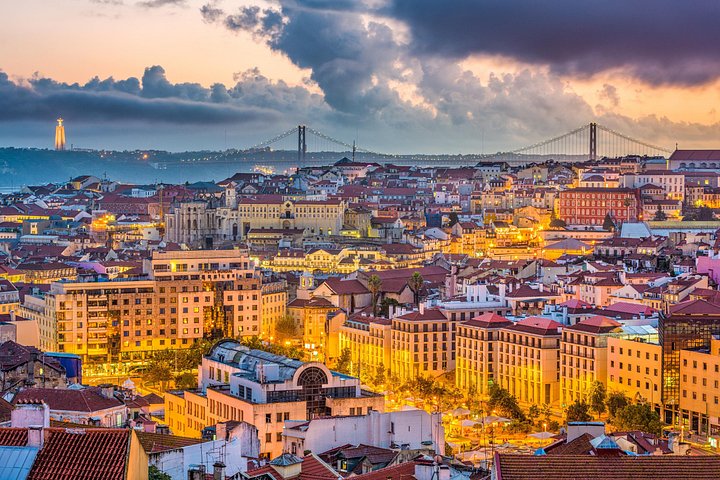
The 25 de Abril Bridge is a road-rail suspension bridge over the Tagus River that connects the city of Lisbon (north bank) to the city of Almada (south bank), in Portugal. The bridge crosses the Tagus estuary in the final and narrowest part — the so-called Tagus bottleneck. The bridge is 2,277 m long. With a free span of 1,013 m, the 25 de Abril Bridge is the 33rd largest suspension bridge in the world. The upper deck houses 6 road routes (3 per direction), while the lower deck houses two electrified railway lines that run from Lisbon to Setúbal. Construction began in November 1962 and lasted four years. It was opened on August 6, 1966, then with just a road deck. On July 29, 1999, the railway deck was inaugurated. Until 1974, the 25 de Abril Bridge was called Ponte Salazar, named after the prime minister who ordered it to be built. The name April 25th alludes to the revolution of April 25th, 1974.
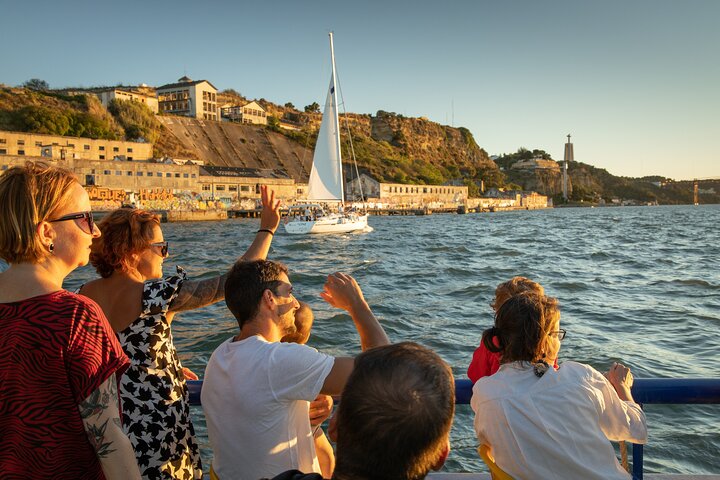
The National Sanctuary of Christ the King, built in 1959, is located at an altitude of 133 meters above the level of the Tagus, consisting of a portico designed by the architect António Lino, 75 meters high, topped by the statue of the Holy Redeemer of open arms facing the city of Lisbon, 28 meters high, the work of Portuguese sculptor Francisco Franco de Sousa. The pedestal, including the portico, rises to a height of 82 meters. The sanctuary and monument to Christ the King is the biggest tourist attraction in the municipality of Almada. This monument is the best viewpoint overlooking the city of Lisbon, offering a wide view over the capital and the 25 de Abril Bridge. In numerous tourist reports about Lisbon, the sanctuary and monument to Christ the King, Almada's landmark, appears. It is one of the tallest buildings in Portugal, measuring 110 meters high.
The 25 DE Abril Bridge is a railway suspended bridge over the Tejo River that connects the city DE Lisbon (north bank) to the city of Almada (south bank), in Portugal. The bridge crosses the Estuary of the Tejo in the final and narrower part — the designated Tejo throat. The Bridge is 2 277 m DE long. With a free run DE 1,013 m, the 25 DE Abril Bridge is the 33rd largest suspended bridge in the world. The upper board houses 6 roadways (3 POR direction), while the lower board houses two electrified rail lines that go DE Lisbon to Setúbal. Construction began in November DE 1962 and lasted POR four years. It was inaugurated on 6 DE August DE 1966, then only with a road board. The railway board was inaugurated on 29 July DE 1999. Until 1974, the 25 DE April Bridge was called the Salazar Bridge, the name of the prime minister who ordered it to be built. The name 25 DE April alludes to the Revolution DE 25 DE April DE 1974.
The Castle DE São Jorge is one of the most iconic monuments DE Lisbon, located on the highest hill DA city. The oldest fortification NO known site dates to the century. I a.C, although traces found here date back to the century C. VI a.C. Archaeology has also allowed DE discover traces of Phoenicians, Greeks, Carthaginians, Romans and Muslims, proving the constant human occupation since ancient times. The castle itself was founded in the 10th and 11th centuries, when Lisbon was an important Muslim port city. In 1147, the first king DE Portugal, D. Afonso Henriques, conquered the castle and the city to the Moors. Between the sec. XIII and the century. XVI had its most important period. NO the century. XVI, it was NO castle that King D. Manuel I received Vasco DA Gama after his sea trip to India. DE clearly National Monument in 1910, it underwent major restoration works during the century. XX, which gave it the current look. You can say that it has the best view DA city and the River Tagus.
FOR as short as the walk DA through the Alfama neighborhood, you will surely pass in front of the lively Miradouro DE Santa Luzia. There, next to the garden and the pergolates, artists and a considerable audience gather NO end OF afternoon. The place, POR itself, is already pleasant: it has flowers, colorful tiles and places to sit. But what makes a viewpoint a special place, we know, is the view. As for this, there is nothing to complain about: from there you can admire the sea DE red roofs DA Alfama until you reach the banks of the Tagus, in the region of the new Cais DE Cruzeiros. The Miradouro DE Santa Luzia is close DE another terrace overlooking the city: the Miradouro das Portas do Sol. It is worth combining the two sights NO same tour
The Lisbon Basilica DE Santa Maria Maior, also known as the Lisbon Basilica DE Santa Maria Maior, is the oldest church in Lisbon and was built NO early DA Segona, after the reconquest of the city by the Moors POR D. Afonso Henriques. It is also the seat OF the Lisbon Patriarchate and PARish OF THE See and has been classified as a National Monument since 1910. The construction of the Lisbon seat began POR around 1147, when the first king OF Portugal, D. Afonso Henriques, reconquered these lands to the Moors. It was built under a Muslim mosque where previously, according to archaeological excavations, was a Christian temple of the Visigoths. The first architect DA was Mestre Roberto, a French who also worked at the Sé DE Coimbra and NO Monastery DE Santa Cruz. It was also at this time that D. Afonso Henriques sent back from the Algarve the relics of the martyr Saint Vincent DE Zaragoza, which are now deposited in the See.
dddddddddddddd
Kostenlose Stornierung bis 24 Stunden vor Beginn, mit voller Rückerstattung.
5,0
Die Bewertungen stammen aus 2 Rezensionen, die unser Buchungspartner gesammelt hat. Es sind die eigenen Worte der Reisenden, in der Reihenfolge ihres Entstehens — nie umsortiert, damit das Erlebnis besser dasteht.
Lissabon fällt von seinen Hügeln zum Tejo hinab: Kachelfassaden, rumpelnde gelbe Trams, Aussichtsterrassen und späte, gemütliche Abendessen.
In den alten Vierteln steckt der meiste Charme. Alfamas Gassengewirr steigt zur Burg São Jorge an und hallt abends vom Fado wider, das geordnete Raster der Baixa führt hinab zur weiten Praça do Comércio am Fluss, und Bairro Alto und Chiado verbinden tagsüber Buchläden und Cafés mit Bars bei Nacht. Aussichtspunkte wie Santa Luzia und Senhora do Monte rahmen rote Dächer und glitzerndes Wasser.
Top-ranked sights in Lissabon: Commerce Square (Praça do Comércio), Pena National Palace (Palacio Nacional da Pena), Alfama.
Streichpreise kommen vom Anbieter, nie von uns.


Ticket Hall zum Home-Bildschirm hinzufügen
Tickets und Stadtführer, nur einen Fingertipp entfernt, auch offline.
Ticket Hall