Private Angkor Wat Day Tour
Die Beschreibungen werden auf Englisch angezeigt.
- 5–7 Stunden
- Kostenlos stornierbar bis 24 Std. vorher
- Führung auf Englisch
- Sofortige Bestätigung
Highlights
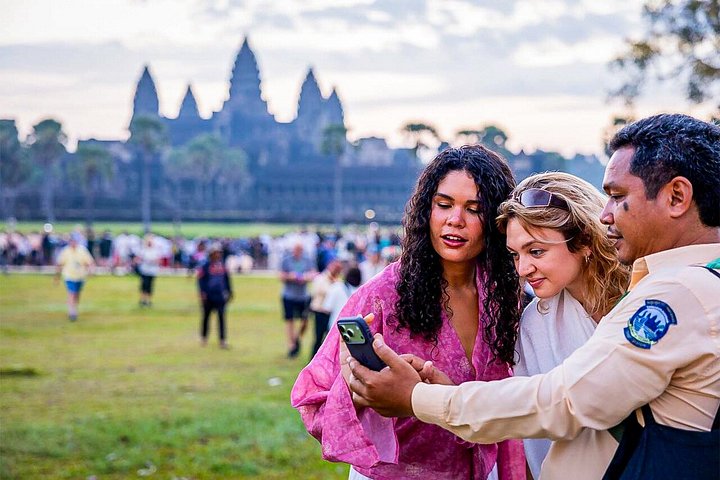
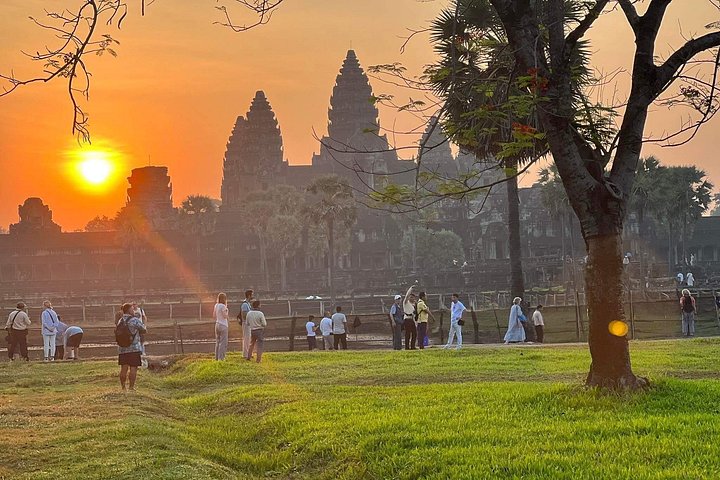
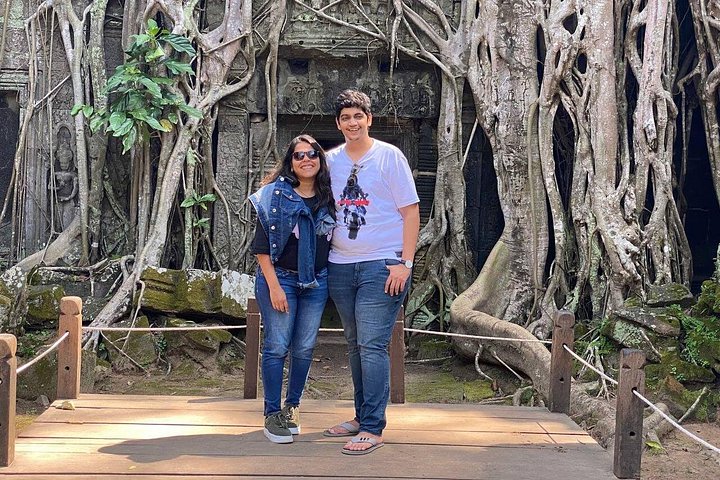
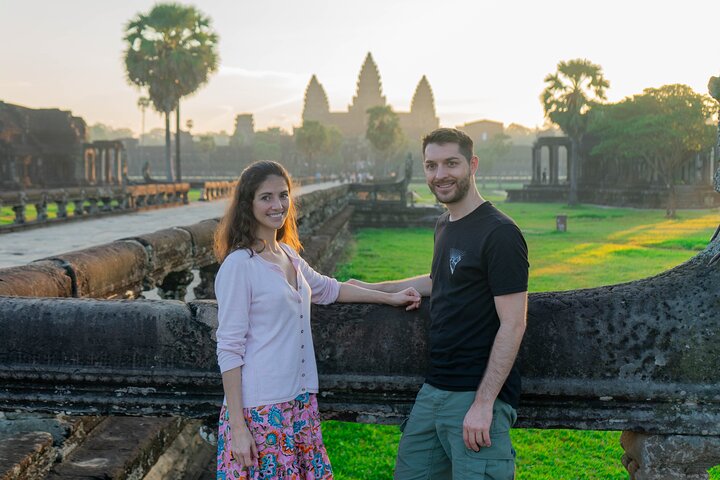
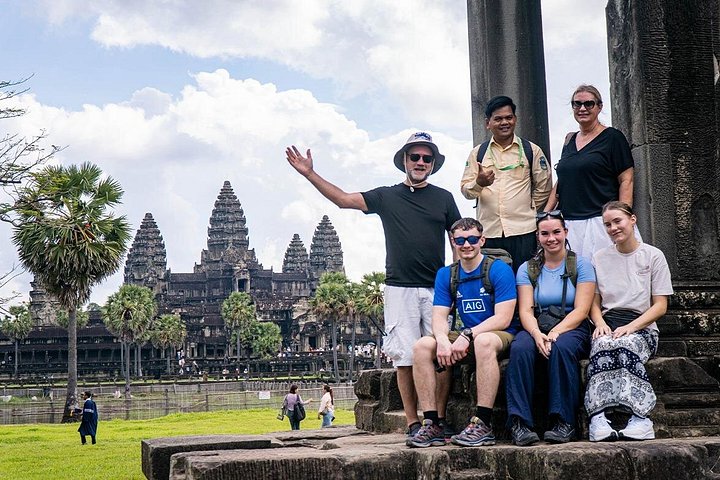
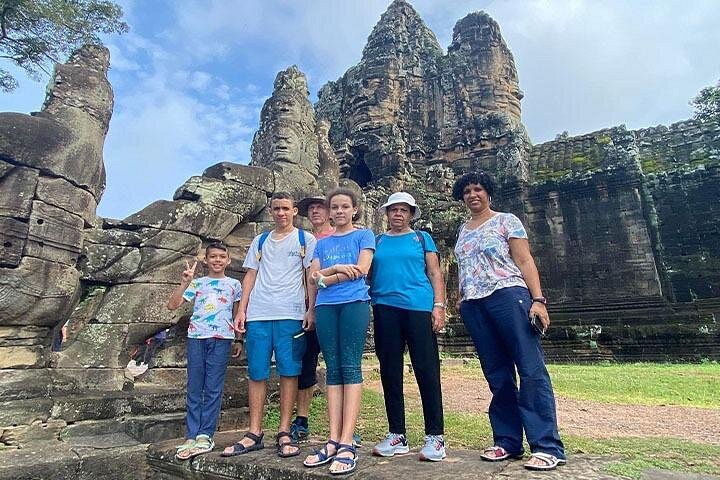
After pickup from your Siem Reap hotel, travel to the Angkor Archaeological Park in the comfort of an air-conditioned minivan. Once you’ve purchased your entrance tickets (not included), set out on a guided tour of the ancient temples. Start by marveling at the much-photographed temple of Angkor Wat and hear the fascinating history of the Khmer Empire as you follow your guide around the impressively preserved ruins. Continue to the walled temple complex of Angkor Thom, pass through the grand South Gate, and visit architectural highlights including Bayon Temple, the Elephant Terrace, and the Terrace of Leper King. After breaking for lunch (own expense), admire the overgrown ruins of Ta Phrom and discover why it’s nicknamed the “Jungle Temple.” Your tour ends with drop-off back at your hotel.
Leistungen
Inbegriffen
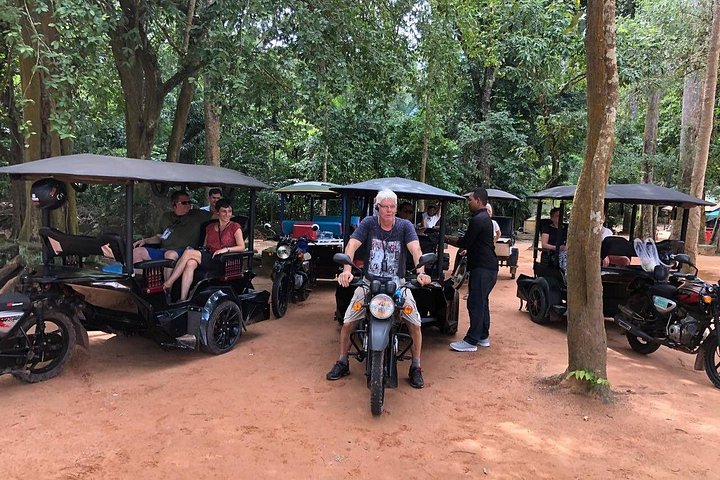
- Transport by tuk tuk for 01-03 pax or by arcon minivan for 04 pax or more
- Experienced English-Speaking Guide
- Private Tour with cold bottled water included
- Hotel pickup and drop off
Nicht inbegriffen
- 1 day entrance ticket to Angkor National Park is 37$ per person (required)
- Lunch and drinks
- Travel insurance
Ablauf
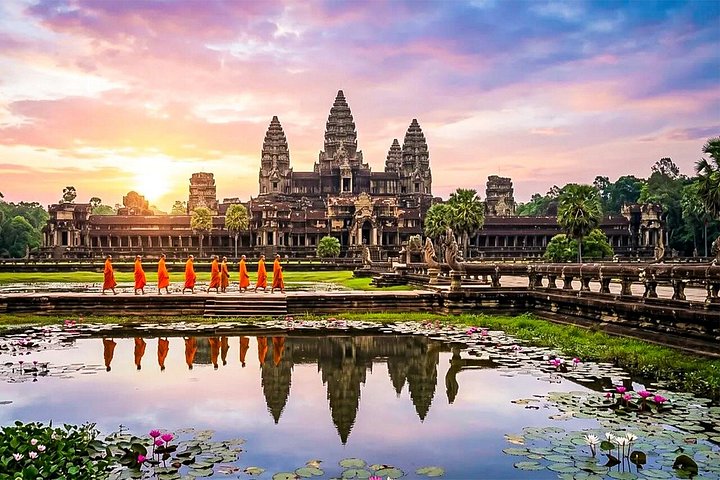
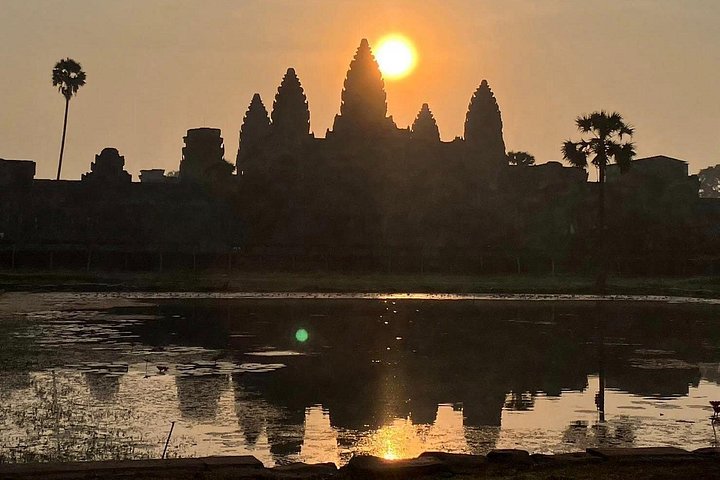
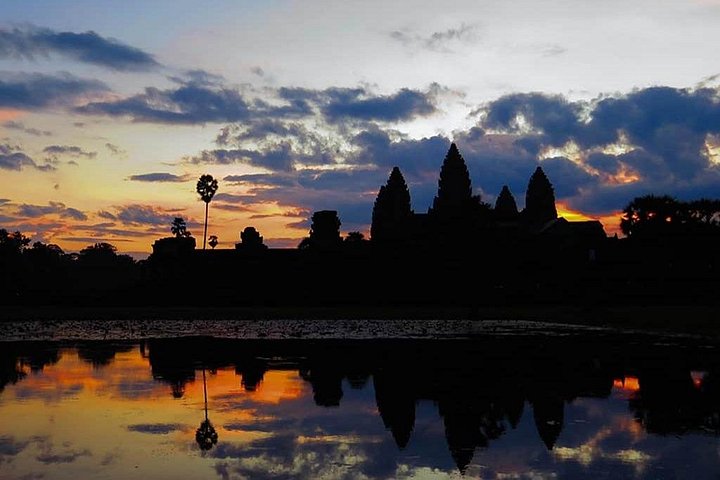
Angkor Wat is a temple complex at Angkor, Cambodia, built for the king Suryavarman II in the early 12th century as his state temple and capital city. As the best-preserved temple at the site, it is the only one to have remained a significant religious centre since its foundation – first Hindu, dedicated to the god Vishnu, then Buddhist. It is the world's largest religious building. The temple is at the top of the high classical style of Khmer architecture. It has become a symbol of Cambodia, appearing on its national flag, and it is the country's prime attraction for visitors. Angkor Wat Temple combines two basic plans of Khmer temple architecture: the temple mountain and the later galleried temple, based on early Indian Hindu architecture, with key features such as the Jagati. It is designed to represent Mount Meru, home of the devas in Hindu mythology: within a moat and an outer wall 3.6 kilometres (2.2 mi) long are three rectangular galleries, each raised above the next. At the centre of the temple stands a quincunx of towers. Unlike most Angkorian temples, Angkor Wat is oriented to the west; scholars are divided as to the significance of this. The temple is admired for the grandeur and harmony of the architecture, its extensive bas-reliefs and for the numerous devatas (guardian spirits) adorning its walls. The modern name, Angkor Wat, means "City Temple"; Angkor is a vernacular form of the word nokor which comes from the Sanskrit word nagara meaning capital or city. Wat is the Khmer word for temple. Prior to this time the temple was known as Preah Pisnulok, after the posthumous title of its founder, Suryavarman II.
Angkor Thom Capital city of the Khmer empire built at the end of the 12th century NameAngkor Thom Datelate 12th century KingJayavarman VII Location North of Angkor Wat, between West Baray and East Baray Near byAngkor Wat, Preah Khan, Phnom Bakheng Angkor Thom is an almost square city surrounded by 8 meter high walls a little over 12 kilometers long with five impressive gopura gates providing access to the city. The city’s name translates to “large city” or “great city”. King Jayavarman VII made Angkor Thom the new capital of the Khmer Kingdom after driving out the Chams , who destroyed the old capital Yasodharapura. He fortified the city by building a high wall around it, in turn enclosed by a 100 meter wide moat.
The Bayon is a richly decorated Khmer temple at Angkor in Cambodia. Built in the late 12th or early 13th century as the state temple of the Mahayana Buddhist King Jayavarman VII, the Bayon stands at the centre of Jayavarman's capital, Angkor Thom. A peculiarity of the Bayon is the absence of an enclosing wall. It is, though, protected by the wall surrounding the city of Angkor Thom. The basic plan of the Bayon is a simple one comprising three levels (1-3). The first and second levels are square galleries featuring bas-reliefs. A circular Central Sanctuary dominates the third level. Despite this seemingly simple plan, the arrangement of the Bayon is complex, with a maze of galleries, passages and steps connected in a way that make the levels practically indistinguishable and creates dim lighting, narrow walkways, and low ceilings. The temples decorated with more than 200 smiling faces on its tower.
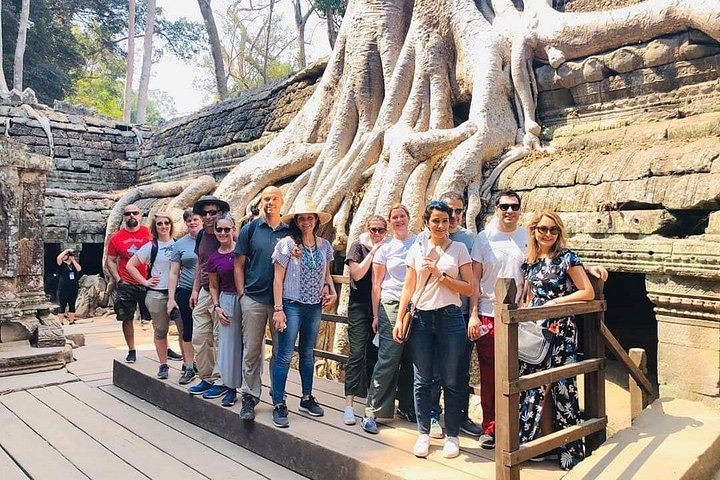
Ta Prohm's state of ruin is a state of beauty, which is investigated with delight and left with regret. Ta Prohm is locating southwest of the East Mebon and east of Angkor Thom. Its outer enclosure is near the corner of Banteay Kdei. It can be accessed by enter the monument from the west and leave from the east entrance. Tip: Ta Prohm is especially serene and beautiful in the early morning. A torch and a compass are useful for visiting this temple at all times. It was built about mid-12th century to early 13th century (1186) by the King Jayavarman VII, dedicated to the mother of the king (Buddhist) replica to Bayon style of art. Ta Prohm is among the largest of the monuments in the Angkor complex, the in scrimption gives an idea of the size of the temple. The complex included 260 statues of gods, 39 towers with pinnacles and 566 groups of residences. Ta Prohm comprises a series of long low buildings standing on one level, which are enclosed by rectangular laterite wall (600 by 1,000 meters, 1,959 by 3,281 feet). Only traces of the wall are still visible. The center of the monument is reached by a series of towers connected with passages. This arrangement forms a ' sort of sacred way into the heart of the monument’; three-square galleries enclose the area.
Stornierung
Kostenlose Stornierung bis 24 Stunden vor Beginn, mit voller Rückerstattung.
Bewertungen
5,0
- 51
- 40
- 30
- 20
- 10
Die Bewertungen stammen aus 1 Rezensionen, die unser Buchungspartner gesammelt hat. Es sind die eigenen Worte der Reisenden, in der Reihenfolge ihres Entstehens — nie umsortiert, damit das Erlebnis besser dasteht.
Gut zu wissen
- Abholung
- Die Abholung ist für alle inbegriffen.
- Tickets
- Die Tickets werden an einem anderen Ort als dem Treffpunkt eingelöst.
- Ticketart
- Mobile or paper ticket accepted
- Gruppengröße
- Bis zu 10 Reisende
- Durchgeführt von
- Angkor Wat Tour Services
- Not recommended for pregnant travelers
- Not recommended for travelers with poor cardiovascular health
- Travelers should have at least a moderate level of physical fitness
How it compares in Siem Reap
- Its from-price is 33% below the median of the 2414 experiences we list in Siem Reap.
- Its length is typical for the group.
- By number of reviews it ranks 1163 of 2414.
- The operator lists free cancellation on it.
About Siem Reap
Siem Reap ist die Flussstadt neben Angkor, Kambodschas riesigem Komplex von Khmer-Tempeln, mit Nachtmärkten, Flusspromenaden und entspanntem Zentrum.
Angkor Wat, oft das größte religiöse Bauwerk der Welt genannt, erhebt sich über seinem Wassergraben in einer Silhouette aus Lotosknospentürmen, die bei Sonnenaufgang atemberaubend ist. Nebenan birgt die ummauerte Stadt Angkor Thom den Bayon mit seinen mehr als zweihundert gelassenen Steingesichtern, die Elefantenterrasse und den Baphuon, während Ta Prohm von den Wurzeln riesiger Kapokbäume und Würgefeigen umklammert wird.
Top-ranked sights in Siem Reap: Angkor Thom, Tonlé Sap, Kampong Phluk.
Sonderangebote in Siem Reap
Streichpreise kommen vom Anbieter, nie von uns.
 10 % RabattKostenlose Stornierung
Ähnliche Erlebnisse
 Kostenlose Stornierung