Palermo Walking Tour with Audio and Written Guide by a Local
Die Beschreibungen werden auf Englisch angezeigt.
- 6–7 Stunden
- Kostenlos stornierbar bis 24 Std. vorher
- 5 Sprachen
- Sofortige Bestätigung
Highlights
If you're looking for a fun and curious way to visit Palermo, you've come to the right place! With this digital guide created with the support of a local, you will be able to visit all the most important monuments at your own pace. You'll get to know the stories and curiosities of Palermo! But also you will discover everything about local foods, Italian Aperitivo in authentic local restaurants, and much more! What are you waiting for?
Leistungen
Inbegriffen
- Best advices for local restaurant with authentic food
- Audio-guide and text in multiple languages (Eng, Esp, Ita, De, Fr)
- Connected with google maps
- Tips for monuments, history and curiosities
- Digital guide to visit the city by yourself
Nicht inbegriffen
- Chiesa degli Eremiti Ticket: 7€
- Palazzo dei Normanni ticket: 17€
- Teatro Massimo ticket: 12€
Ablauf
The Church of San Giovanni degli Eremiti in Palermo is a monument of great charm, part of the UNESCO itinerary “Arab-Norman Palermo and the Cathedrals of Cefalù and Monreale.” The complex stands on a site with a long religious tradition, which first included a monastery dedicated to Saint Hermes and, during the Muslim domination, a mosque. The church was later entrusted to the Benedictines and became an important religious center. During this period the abbot also acted as the King’s confessor.
The Norman Palace, also known as the Royal Palace, is one of the most significant and historically relevant monuments in Palermo. It is the oldest royal palace in Europe. The Norman Palace stands on an older structure, dating back to the Punic-Roman period. In the underground areas that can still be visited, it is even possible to see the remains of the first Punic settlements.
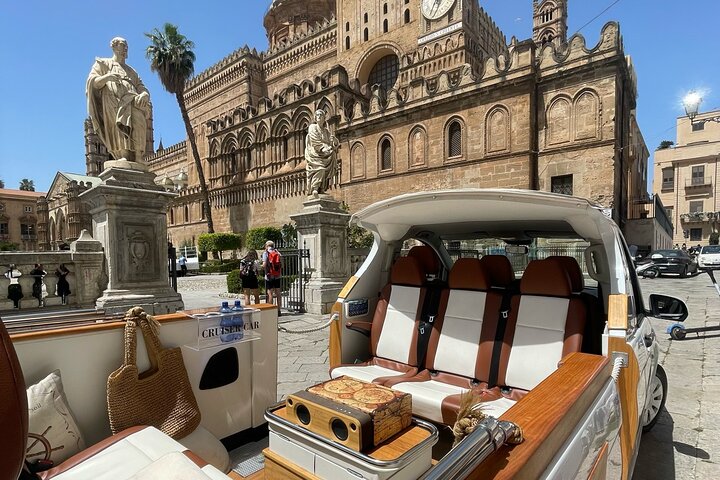
Palermo Cathedral combines Byzantine, Islamic and Latin elements and has been recognized as a World Heritage Site by UNESCO. The cathedral is an important site of Christian worship and houses the Diocesan Museum and the Chapel with the relics of Santa Rosalia, patron saint of the city, as well as the tombs of the Norman kings.
The Teatro Massimo in Palermo is the largest opera house in Italy and the third in Europe. Situated in a strategic position, on the border between the old city and the northern expansion, this imposing neoclassical building was designed by Giovanni Battista Filippo Basile.
Piazza Villena, known to the people of Palermo as Piazza dei Quattro Canti, was created in the Palermo of the seventeenth century where the new Via Maqueda, commissioned by the viceroy from whom it takes its name, met the already existing Via Vittorio Emanuele, also known as the Cassaro. This intersection determined the division of the city into four districts, called “Mandamenti”.
Piazza Pretoria is one of the most famous and fascinating squares in Palermo, located in the heart of the historic center of the city, also known as “Piazza della Vergogna” (Square of Shame) because of the fountain in the center of the square itself.
You can’t stay in Palermo without visiting at least once one of the city’s historic markets. The most important are La Vucciria, Capo and Ballarò. he Vucciria market is located in the historic Loggia district, between Via Roma, Piazza San Domenico and Via Vittorio Emanuele. In the past, this market was one of the liveliest and most chaotic in the city center, and its name derives from the French “boucherie” which means “butcher’s shop”, since meat was originally sold here.
Kalsa is one of the oldest neighborhoods in Palermo, dating back to the era of Islamic domination. The Kalsa still retains an oriental atmosphere today, accentuated by the presence of monuments in Arab-Norman style.
Palazzo Abatellis, located in Piazza Magione, is a prestigious example of Gothic and Renaissance architecture, built in the 15th century for Francesco Abatellis, a Sicilian nobleman. Designed by Matteo Carnilivari, the building combines Gothic elements with Renaissance influences.
If you like majolica, this private collection is just right for you. The collection, distributed in eight rooms, is divided by era and geographical origin. It includes tiles produced mainly in Campania and Sicily between the 15th and 19th centuries, used for floors in noble and bourgeois homes.
Stornierung
Kostenlose Stornierung bis 24 Stunden vor Beginn, mit voller Rückerstattung.
Bewertungen
4,3
- 522
- 46
- 31
- 22
- 12
Die Bewertungen stammen aus 33 Rezensionen, die unser Buchungspartner gesammelt hat. Es sind die eigenen Worte der Reisenden, in der Reihenfolge ihres Entstehens — nie umsortiert, damit das Erlebnis besser dasteht.
Gut zu wissen
- Treffpunkt
- My itinerary starts out from this church! However, you can access to the digital guide even before getting here!
- Abholung
- Alle treffen sich am Startpunkt; eine Abholung gibt es nicht.
- Ticketart
- Mobile or paper ticket accepted
- Gruppengröße
- Bis zu 104 Reisende
- Durchgeführt von
- Walking Cap
- Wheelchair accessible
- Infants and small children can ride in a pram or stroller
- Service animals allowed
- Public transportation options are available nearby
- Suitable for all physical fitness levels
- You will need a smartphone with internet connection to use the digital guide (details to activate the digital guide will be in your voucher, read it carefully!)
- You'll be able to hear the audio through your speakers or, if you have them, through your headphones
How it compares in Palermo
- Its from-price is 98% below the median of the 22 stadtbesichtigungen we list in Palermo.
- Its length is typical for the group.
- By number of reviews it ranks 7 of 22.
- The operator lists free cancellation on it.
About Palermo
Palermo, capital of Sicily, is a port city of Arab-Norman palaces, gilded mosaics, baroque crossroads and street food.
Palermo was founded by the Phoenicians and later ruled by Arabs, Normans and Spaniards, and the layers show in its buildings. The Norman Palace holds the Palatine Chapel, glittering with gold mosaics, and the cathedral mixes Norman, Gothic and Baroque styles. The Arab-Norman monuments, with the cathedrals of Monreale and Cefalù, are listed by UNESCO.
Top-ranked sights in Palermo: Massimo Opera House (Teatro Massimo), Capo Market (Mercato di Capo), Vucciria Market (La Vucciria).
Sonderangebote in Palermo
Streichpreise kommen vom Anbieter, nie von uns.
 5 % RabattKostenlose Stornierung
![Palermo Sicilian Street Food Tour: Small Group by Do Eat Better]() 6 % RabattKostenlose Stornierung
![Private 4-hours Tour of Palermo with pick up and drop off]() 5 % RabattKostenlose Stornierung
![Airport Transfer: Palermo Airport PMO to Palermo by Luxury Van]() 5 % RabattKostenlose Stornierung




Ähnliche Erlebnisse
 Schnell ausgebuchtKostenlose Stornierung