10 % RabattKostenlose Stornierung
Kategorien in Neu-Delhi
Die Beschreibungen werden auf Englisch angezeigt.
Delhi is one of the most unique and mesmerizing cities in the world. There's something about its chaotic energy and colorful culture that makes it irresistible. Whether you're a first-time visitor or a lifelong resident, there's always something new to discover in Delhi. So what makes Delhi tour so unique? Here are just a few of the things that make it special: Delhi is one of the oldest cities in the world, with a rich culture and history that dates back thousands of years. From the ancient temples and forts to the bustling markets and bazaars, there's no shortage of things to see and do in Delhi. Delhi is known for its delicious food, and you can find everything from traditional Indian cuisine to international fare. There are also plenty of street food vendors, so you can try a little bit of everything.
The Laxminarayan Temple in Delhi was the first temple erected by the Birla family in 1939. The temple, which is located in a prominent location, was planned to be high and expansive, suited for communal worship or speeches. Despite being created with contemporary technologies, it adhered to the Nagara style very loosely.
Gurudwara Bangla Sahib is a notable Sikh gurdwara, or Sikh temple of worship, in Delhi, India, and is noted for its affiliation with the eighth Sikh Guru, Guru Har Krishan, as well as the sacred pond known as the "Sarovar" inside its complex. It was founded in 1783 as a tiny shrine by Sikh General Sardar Baghel Singh on the villa granted by King Raja Jai Singh of Amer, who also oversaw the construction of nine Sikh temples in Delhi that year, under the reign of Mughal Emperor Shah Alam II.
Humayun's mausoleum is the Mughal Emperor Humayun's tomb in Delhi, India. The mausoleum was commissioned in 1558 by Humayun's principal consort, Empress Bega Begum (also known as Haji Begum), and created by Persian architects Mirak Mirza Ghiyas and his son, Sayyid Muhammad. It is located in Nizamuddin East, Delhi, India, near the Dina-panah Citadel, also known as Purana Qila (Old Fort), which Humayun discovered in 1533. It was also the first construction of its size to employ red sandstone. In 1993, the mausoleum was designated a UNESCO World Heritage Site.
The Masjid-i Jehan-Numa (literally "World-reflecting Mosque"), also known as the Jama Masjid of Delhi, is one of India's biggest mosques. It was established between 1650 and 1656 by Mughal Emperor Shah Jahan and dedicated by its first Imam, Syed Abdul Ghafoor Shah Bukhari. It functioned as the imperial mosque of the Mughal emperors until the empire's fall in 1857, and was located in the Mughal capital of Shahjahanabad (now Old Delhi). The Jama Masjid was seen as a symbolic centre of Islamic influence across India, as well as a political location during various crucial eras of British administration. It is still in use today and is one of Delhi's most famous landmarks, intimately associated with the spirit of Old Delhi.
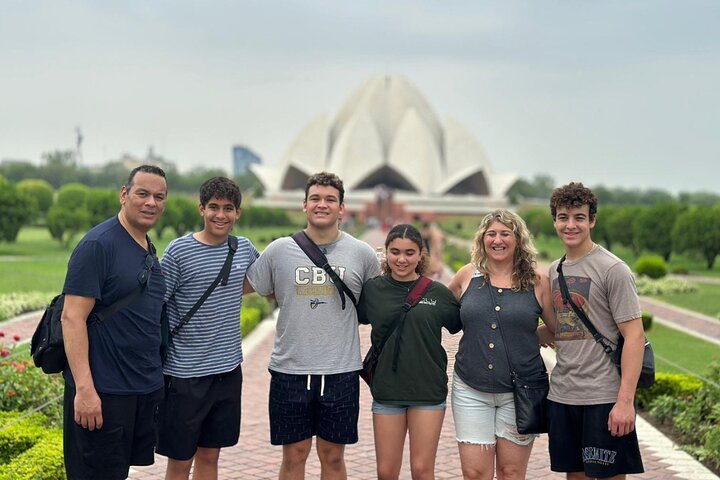
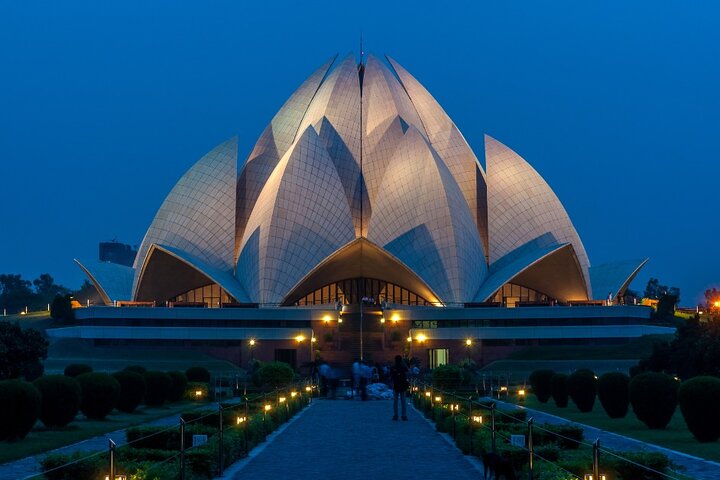
The Lotus Temple is a Bahá House of Worship in Delhi, India, that was consecrated in December 1986. It has become a popular tourist attraction in the city due to its flower-like design. The Lotus Temple, like all other Bahá' Houses of Worship, is open to all, regardless of religion or other qualification. The structure is made up of 27 free-standing marble-clad "petals" grouped in three-petal clusters to form nine sides, with nine portals opening into a central hall with a height of slightly more than 34 metres and seating for 1,300 people. The Lotus Temple has received multiple architectural honours and has appeared in countless newspaper and magazine publications.
The Qutub Minar, also known as the Qutb Minar and the Qutab Minar, is a minaret and "victory tower" that is part of the Qutb complex, which is located on the site of Lal Kot, Delhi's earliest walled city constructed by the Tomar Rajputs. It is a UNESCO World Heritage Site located in the Mehrauli neighbourhood of South Delhi, India. It is one of the city's most popular tourist attractions, largely erected between 1199 and 1220, and was built a decade or two before the likely commencement of the Delhi Tower. Both have richly adorned surfaces with inscriptions and geometric motifs. The shaft of the Qutb Minar is fluted, with "superb stalactite bracketing under the balconies" at the top of each step.
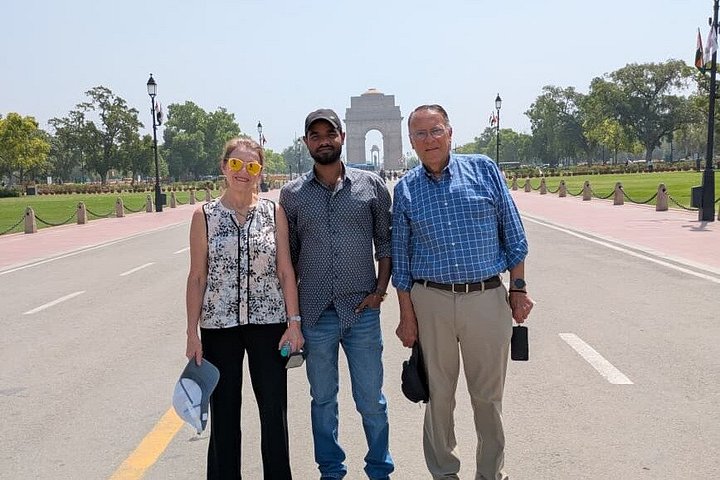
The India Gate (previously known as the All India Military Memorial) is a war memorial located on the Rajpath, on the eastern border of New Delhi's "ceremonial axis," formerly known as Kingsway. It is a memorial to the 84,000 British Indian Army personnel who perished between 1914 and 1921 in the First World War, in France, Flanders, Mesopotamia, Persia, East Africa, Gallipoli, and elsewhere in the Near and Far East, as well as the Third Anglo-Afghan War. The names of 13,300 personnel, including several British soldiers and officers, are etched on the gate.
The Rashtrapati Bhavan (literally, "Presidential Palace"; initially Viceroy's House and subsequently Government House) is the official house of India's President, located at the western end of Rajpath in New Delhi, India. Rashtrapati Bhavan may refer to the 340-room main building that houses the president's official residence, including reception halls, guest rooms, and offices, also known as the mansion; it may also refer to the entire 130-hectare (320-acre) Presidential Estate, which includes the presidential gardens, large open spaces, bodyguard and staff residences, stables, other offices, and utilities within its perimeter walls. It is the world's largest house for a head of state in terms of area.
Kostenlose Stornierung bis 24 Stunden vor Beginn, mit voller Rückerstattung.
4,8
Die Bewertungen stammen aus 22 Rezensionen, die unser Buchungspartner gesammelt hat. Es sind die eigenen Worte der Reisenden, in der Reihenfolge ihres Entstehens — nie umsortiert, damit das Erlebnis besser dasteht.
Neu-Delhi verbindet die stattlichen Alleen der Hauptstadt mit den Basaren und Mogulbauten Alt-Delhis: Reiche in Schichten und großartiges Essen.
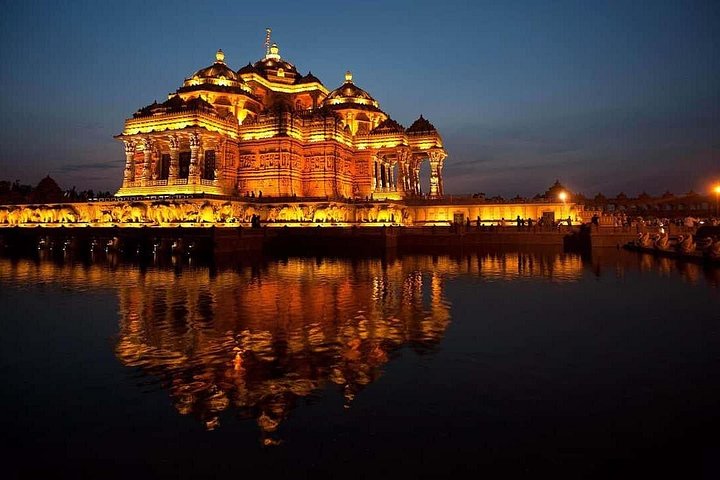
Die geplante Hauptstadt ist auf eine große Prachtstraße ausgerichtet, die vom India Gate zum Rashtrapati Bhavan, dem Präsidentenpalast, führt. In der Nähe liegt Humayuns Grabmal, ein Vorläufer des Taj Mahal, in formalen Gärten, und im Süden ragt der Qutb Minar auf, ein hohes Minarett aus Sandstein. Der Lotustempel und die riesige Anlage von Akshardham setzen markante moderne Akzente.
Top-ranked sights in Neu-Delhi: India Gate, Jama Masjid (Masjid e Jahan Numa), Chandni Chowk.
Streichpreise kommen vom Anbieter, nie von uns.



Ticket Hall zum Home-Bildschirm hinzufügen
Tickets und Stadtführer, nur einen Fingertipp entfernt, auch offline.
Ticket Hall