Private Day-Tour of Ancient Battle Fields (Troy & Gallipoli)
Beskrivelserne vises på engelsk.
- 12 timer
- Uden kø
- Gratis afbestilling indtil 24 t før
- 9 sprog
Højdepunkter
Enhance your Trojan experience by visiting another site where the souls of heroes are present. You will also travel by the shores of the Dardanelles, as you will pass by Gallipoli, and other land of gallantry where the famous “Gentlemen’s War” was fought between the Ottoman and Anzac troops during the WW1. Scenic ferry ride from Europe to Asia across the Dardanelles
Inkluderet
Det er inkluderet
- Knowledgable & Professional Tour Guide
- Transportation from/to your base-location in Istanbul.
- Skip-the-line access with your guide.
Ikke inkluderet
- Meals & Drinks.
- Gratuities
- Museum entrance ticket fees
Rute
The Dardanelles(Greek: Δαρδανέλλια, romanized: Dardanéllia), also known from Classical Antiquity as the Hellespont (/ˈhɛlɪspɒnt/; Classical Greek: Ἑλλήσποντος, romanized: Hellēspontos, lit. 'Sea of Helle'), is a narrow, natural strait and internationally significant waterway in northwestern Turkey that forms part of the continental boundary between Europe and Asia, and separates Asian Turkey from European Turkey. One of the world's narrowest straits used for international navigation, the Dardanelles connects the Sea of Marmara with the Aegean and Mediterranean Seas, while also allowing passage to the Black Sea by extension via the Bosphorus. The English name Dardanelles is an abbreviation of Strait of the Dardanelles. During Ottoman times there was a castle on each side of the strait. These castles together were called the Dardanelles, probably named after Dardanus, an ancient city on the Asian shore of the strait which in turn was said to take its name from Dardanus, son of Zeus.
The Trojan Horse is a story from the Trojan War about the subterfuge that the Greeks used to enter the independent city of Troy and win the war. In the canonical version, after a fruitless 10-year siege, the Greeks constructed a huge wooden horse and hid a select force of men inside, including Odysseus. The Greeks pretended to sail away, and the Trojans pulled the horse into their city as a victory trophy. That night the Greek force crept out of the horse and opened the gates for the rest of the Greek army, which had sailed back under cover of night. The Greeks entered and destroyed the city of Troy, ending the war. Metaphorically, a "Trojan horse" has come to mean any trick or stratagem that causes a target to invite a foe into a securely protected bastion or place. A malicious computer program that tricks users into willingly running it is also called a "Trojan horse" or simply a "Trojan".
Much of the surrounding area is visible from the ancient Temple of Athena, built on top of a trachyte crag. The view from this temple on a clear day extends to nearby Lesbos in the south, Pergamum in the southeast, and Mount Ida in Phrygia in the east. To the north, the Tuzla River flows. To the northwest, two massive Hellenic columns still mark the gate to the city.
After leaving the Platonic Academy in Athens, Aristotle (joined by Xenocrates) went to Assos, where he was welcomed by King Hermias, and opened an Academy in this city. Aristotle also married Pythias, the adopted daughter of Hermias. In the Academy of Assos, Aristotle became a chief to a group of philosophers, and together with them, he made innovative observations on zoology and biology. When the Persians attacked Assos, King Hermias was caught and put to death. Aristotle fled to Macedonia, which was ruled by his friend King Philip II of Macedon. There, he tutored Philip's son, Alexander the Great. There is a modern statue of Aristotle at the town entrance.
The Gallipoli campaign, also known as the Dardanelles campaign, the Battle of Gallipoli or the Battle of Çanakkale (Turkish: Çanakkale Savaşı), was a campaign of the First World War that took place on the Gallipoli peninsula (Gelibolu in modern Turkey), from 17 February 1915 to 9 January 1916. The Entente powers, Britain, France and Russia, sought to weaken the Ottoman Empire, one of the Central Powers, by taking control of the straits that provided a supply route to the Russian Empire. The Allies' attack on Ottoman forts at the entrance of the Dardanelles in February 1915 failed and was followed by an amphibious landing on the Gallipoli peninsula in April 1915 to capture the Ottoman capital of Constantinople (Istanbul).
The landing at Anzac Cove on Sunday, 25 April 1915, also known as the landing at Gaba Tepe, and to the Turks as the Arıburnu Battle, was part of the amphibious invasion of the Gallipoli Peninsula by the forces of the British Empire, which began the land phase of the Gallipoli Campaign of the First World War. The assault troops, mostly from the Australian and New Zealand Army Corps (ANZAC), landed at night on the western (Aegean Sea) side of the peninsula. They were put ashore one mile (1.6 km) north of their intended landing beach. In the darkness, the assault formations became mixed up, but the troops gradually made their way inland, under increasing opposition from the Ottoman Turkish defenders.[nb 1] Not long after coming ashore the ANZAC plans were discarded, and the companies and battalions were thrown into battle piece-meal, and received mixed orders. Some advanced to their designated objectives while others were diverted to other areas.
Afbestilling
Gratis afbestilling indtil 24 timer før oplevelsen starter, med fuld refusion.
Anmeldelser
4,6
- 56
- 41
- 31
- 20
- 10
Bedømmelserne kommer fra 8 anmeldelser, som vores bookingpartner har indsamlet. Det er de rejsendes egne ord, i den rækkefølge de blev skrevet — aldrig omrokeret for at pynte på oplevelsen.
Godt at vide
- Afhentning
- Afhentning er inkluderet for alle.
- Billettype
- Mobile or paper ticket accepted
- Udføres af
- TRAVELIUM
- Infants and small children can ride in a pram or stroller
- Infants are required to sit on an adult’s lap
- Not recommended for travelers with spinal injuries
- Travelers should have at least a moderate level of physical fitness
How it compares in Istanbul
- Its from-price is 243% above the median of the 3649 experiences we list in Istanbul.
- It is longer than most of them.
- By number of reviews it ranks 1060 of 3649.
- The operator lists free cancellation on it.
About Istanbul
Istanbul strækker sig over Europa og Asien ved Bosporus, med byzantinske og osmanniske monumenter, travle basarer og færger mellem kontinenterne.
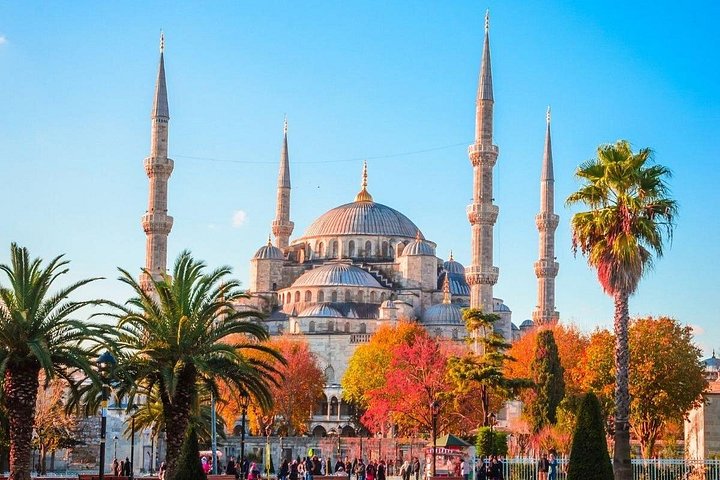
Den historiske halvø rummer de største vartegn. Hagia Sophia, Den Blå Moské og Hippodromen vender mod hinanden i Sultanahmet, Basilikacisternen ligger under gaderne, og Topkapi-paladset breder sig over bakken over Det Gyldne Horn. En kort gåtur væk har Den Store Basar og Krydderibasaren handlet i århundreder, og Süleymaniye-moskeen, bygget af den store osmanniske arkitekt Sinan, kroner en af byens syv høje.
Top-ranked sights in Istanbul: Dolmabahce Palace (Dolmabahce Sarayi), Bosphorus, Bosphorus Bridge (Bogazici Koprusu).
Særtilbud i Istanbul
Før/nu-priser kommer fra udbyderen, aldrig fra os.
 7% rabatGratis afbestilling
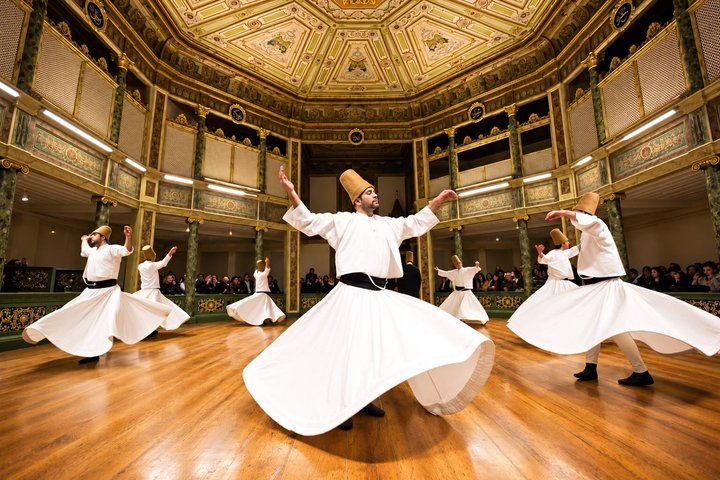
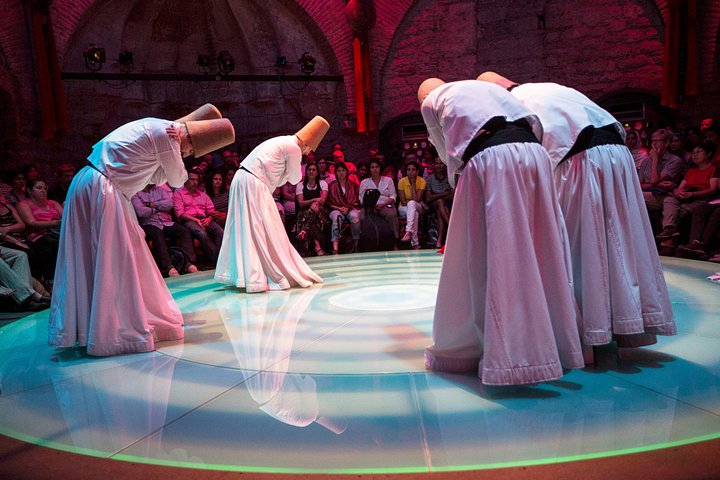
Istanbul Traditionel tyrkisk middag og Dervish oplevelse
fra
107 US$100 US$ 5% rabatGratis afbestilling
![Det bedste ved Istanbul: 1, 2 eller 3 dages privat guidet tur]() 15% rabatGratis afbestilling
![Istanbul Shore Excursion: Bestseller Private Istanbul Tour]() 22% rabatGratis afbestilling
Istanbul Shore Excursion: Bestseller Private Istanbul Tour
fra
100 US$78 US$
Lignende oplevelser
 Gratis afbestilling