8% rabatGratis afbestilling
1DAY Hiroshima Miyajima & Bomb Dome Private Tour (No Private Car)
fra226 US$208 US$
Beskrivelserne vises på engelsk.
Explore Onomichi with a government-licensed and experienced English speaking guide! Your guide will help you make the most of a full-day walking tour of Onomichi, highlighting its breathtaking natural beauty, serene landscapes, and traditional charm. Located just a short trip from Hiroshima, Onomichi is an ideal destination for day trip. The city is an old town with narrow streets, temples, and traditional wooden houses. It's particularly famous for its scenic hills and the view from the Onomichi Hilltop Park. Start your tour from your hotel in Hiroshima, and let us know your preferences! We’ll create a customized itinerary tailored to your interests. You can see 3 to 4 sights from the itinerary list to visit. Hiroshima and Onomichi Station are connected by frequent JR Sanyo Line trains (90 min, ticket not included). There are a few direct trains per day, but the trip usually requires a transfer at Itozaki Station. Fully covered by the Japan Rail Pass. No Bicycles Allowed.
Departure from Hiroshima station on train to Onomichi with your guide! Hiroshima and Onomichi Station are connected by frequent JR Sanyo Line trains (90 min, ticket not included). There are a few direct trains per day, but the trip usually requires a transfer at Itozaki Station. Fully covered by the Japan Rail Pass.
Senkō-ji is the best known and most impressive of Onomichi's temples. Among its features is the kyō-onrō, a bell tower whose bell always rings in the new year – the sound of this bell is registered as one of the '100 soundscapes of Japan'. The temple appears almost grown into the hillside, with views out to sea, and is reachable on the historic temple walk (after a steep 15- to 25-minute hike for most) or by the Senkō-ji-yama Ropeway.
Tatara Bridge, with the center span of 890 m long, is the second longest span cable stayed bridge in the world. Suspension bridge was planned at the first stage; however, the bridge type was reviewed considering the preservation of surrounding nature and economical condition of the work, against the background of the technical progress of cable stayed bridges. The height of the tower is 226 m above the seawater level, and this is the highest point in the route. Tatara Bridge formed a sister bridge alliance with Normandy Bridge in France which is the third longest cable stayed bridge in the world.
Neko no Hosomichi goes on for about 200m from the eastern side of Ushitora Shrine to the three-floor pagoda of Tennei-ji Temple. The area was given its name due to the many Fukuishi Cats (stones with cats painted on them) left there. The cats were painted by Shunji Sonoyama, an artist who lives in Onomichi. In the area, there is also the Maneki-neko Museum where you can enjoy the scene of “cats and Onomichi”.
Hirayama Ikuo was one of Japan's most famous painters, working in the traditional Japanese Nihonga style. The Hirayama Ikuo Museum of Art (平山郁夫美術館, Hirayama Ikuo Bijutsukan) is located on Ikuchijima Island, where the artist was born in 1930. Hirayama passed away in 2009. Many of the themes in Hirayama's work have persisted throughout his entire career. One is the concept of peace. Hirayama was a student in Hiroshima in 1945, and as such witnessed the destruction of the bomb and suffered from the effects of radiation. Another of his recurring themes was the cultural exchanges within the Orient, particularly the transmission of Buddhism to Japan. The Hirayama Museum is quite modern and well kept. There are three spacious exhibition halls, a tea lounge, and a museum shop. A variety of Hirayama's work from throughout his career are kept as part of the museum's permanent collection, and there are also special exhibitions.
Kosanji Temple (耕三寺, Kōsanji) is located on Ikuchijima Island and belongs to the True Pure Land Sect of Japanese Buddhism. The temple was founded in 1936 by a successful businessman who was inspired by his devotion to his mother. The construction of the temple took more than 30 years. If visitors to the temple are surprised by a strong feeling of deja vu, it is because many of the buildings are modeled after some of Japan's most famous temple buildings. The replicas of famous buildings at Kosanji are quite impressive, including copies of Nikko Toshogu's Yomeimon Gate and Byodoin's Phoenix Hall. The complex of buildings at the temple are on the whole colorful and varied, while still retaining a coherent style. Another highlight of the temple is a long cave in which a series of images are displayed that illustrate the tortures of Buddhist hell.
With a total length of 1270 meters, Innoshima Bridge connects Mukaishima Island with Innoshima Island, and is one of the bridges that forms Shimanami Kaido. At its foot on the Innoshima Island side, you’ll find Innoshima Bridge Memorial Park.
Mukaishima Island is located across from Onomichi in Hiroshima. Known for its scenic coastline, citrus orchards, and peaceful atmosphere, it’s a popular spot for cycling and enjoying the natural beauty of the Shimanami Kaido.
This temple was built by Yoshiakira Ashikaga, the second shogun in the Muromachi Period, in 1367 and founded by Fumyo Kokushi. It has a pagoda called Kaiun Pagoda, an important cultural property, and a group of 500 arhats line the Rakan Hall on the left side of the main hall. Weeping cherry blossoms in the beginning of April and peonies at the end of April are things you should not miss.
Onomichi Shopping Street is a 1.2-kilometer arcade lined with traditional shops, cozy cafes, and unique stores. Blending old-world charm with modern appeal, it’s a perfect spot to explore local products and enjoy the warm hospitality of Onomichi.
Return to Hiroshima-city with your guide via train
Gratis afbestilling indtil 24 timer før oplevelsen starter, med fuld refusion.
5,0
Bedømmelserne kommer fra 2 anmeldelser, som vores bookingpartner har indsamlet. Det er de rejsendes egne ord, i den rækkefølge de blev skrevet — aldrig omrokeret for at pynte på oplevelsen.
Hiroshima, on Japan's Seto Inland Sea, is a rebuilt river city whose Peace Memorial Park and museum recall the atomic bombing of 1945.
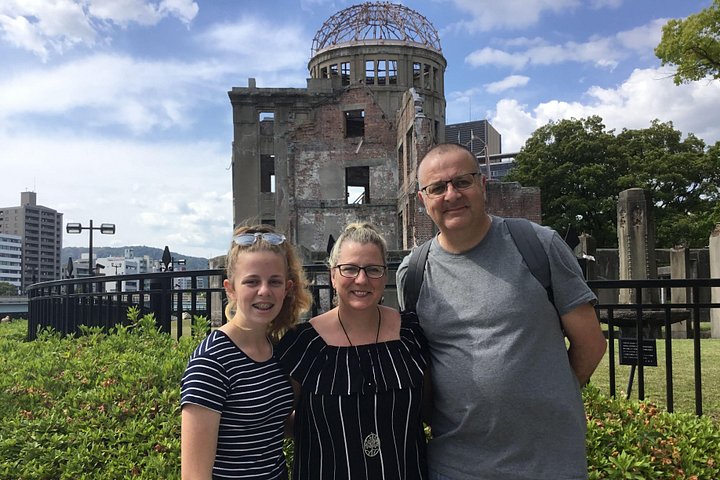
Hiroshima spreads across the delta of the Ōta River, whose channels, bridges and trams give the city an open feel. The atomic bomb of 6 August 1945 destroyed most of it. The Peace Memorial Park beside the river holds the Atomic Bomb Dome, a ruined building left standing and listed by UNESCO, the Peace Memorial Museum and the Children's Peace Monument.
Top-ranked sights in Hiroshima: Hiroshima Peace Memorial Museum, Hiroshima Peace Memorial Park, Miyajima Island (Itsukushima).
Før/nu-priser kommer fra udbyderen, aldrig fra os.
fra226 US$208 US$
fra100 US$95 US$
fra110 US$101 US$
fra290 US$232 US$
fra142 US$121 US$
Føj Ticket Hall til din hjemmeskærm
Billetter og byguider, ét tryk væk, også offline.
Ticket Hall