3rd Reich Tour Nuremberg
説明は英語で表示されます。
- 2時間15分
- 24時間前まで無料キャンセル
- 英語のガイド付き
- モバイルチケット
見どころ
This tour is designed by a born and raised Nuremberg local. It includes the history of the rally grounds, as well as a brief overview of the Nuremberg laws and Nuremberg trials. Beside the historical aspects we also discus Nurembergs way to deal with its Nazi-heritage and how the 3rd Reichs history is reflected in our modern education, collective memory and culture.
含まれるもの
料金に含まれるもの
- Local tourguide fluent in English language
含まれないもの
- Tips
行程
The Kongresshalle in Nuremberg, part of the former Nazi Party Rally Grounds, was designed by architects Ludwig Ruff and Franz Ruff in the 1930s. Inspired by Rome's Colosseum, it was intended to host 50,000 people but was never completed due to WWII. The massive, horseshoe-shaped structure stands as a haunting symbol of Nazi ambition and propaganda. Post-war, it was left largely untouched and now houses the Documentation Center, which educates visitors about the Nazi era, preserving the site as a powerful reminder of Germany’s history.
The Luitpoldarena in Nuremberg was a vast parade ground built in the 1930s for Nazi Party rallies, capable of hosting over 100,000 people. It was built around "Ehrenhalle" (Hall of honor) for the WWI veterans. While the Nazis missused it for honoring the fallen "old-comrades" of the "Hitlerputsch" it is now used as a public park, preserving some remnants as a somber reminder of Nazi history and the dangers of totalitarianism.
The "Great Street" at the Nazi Party Rally Grounds in Nuremberg was a 1.5-mile-long granite road designed by Albert Speer as a central axis for marches and parades. Oriented toward the imperial city of Nuremberg, it symbolized the Nazis' attempt to link their regime to Germany's historic past. The street was intended for grand military processions and formations during rallies but was barely used due to the outbreak of WWII.
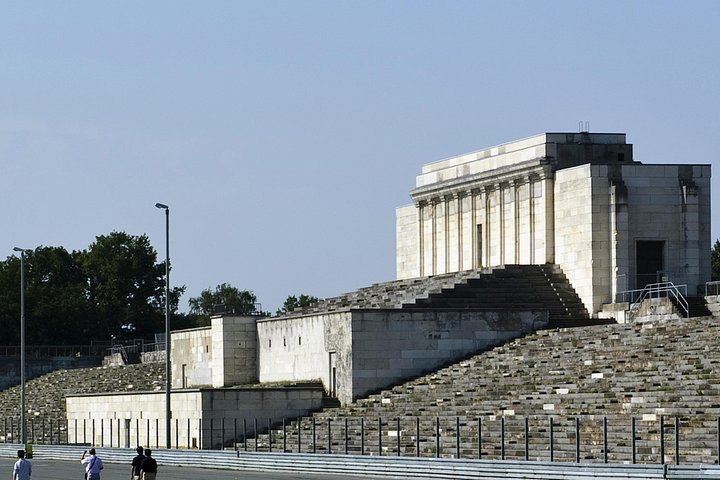
The Zeppelinfeld in Nuremberg was a major site of Nazi Party rallies, designed by Albert Speer in the 1930s. It featured a massive grandstand inspired by ancient Greek and Roman architecture, with a central platform where Hitler addressed crowds of up to 200,000 people. Iconic for its huge swastika, which was famously blown up by Allied forces after WWII, the site symbolized Nazi power.
キャンセル
開始24時間前まで無料でキャンセルでき、全額返金されます。
口コミ
4.9
- 518
- 41
- 30
- 20
- 10
評価は予約パートナーが集めた19件の口コミによるものです。旅行者自身の言葉を書かれた順に掲載しており、体験をよく見せるために並べ替えることはありません。
参加前に知っておくこと
- 集合場所
- Look for the white umbrella with the green logo
- 送迎
- 全員が出発場所で合流します。送迎はありません。
- チケットの種類
- Mobile or paper ticket accepted
- グループの人数
- 最大25名
- 催行会社
- Nuremberg Free Walking Tour
- Wheelchair accessible
- Infants and small children can ride in a pram or stroller
- Service animals allowed
- Public transportation options are available nearby
- Transportation options are wheelchair accessible
- Travelers should have at least a moderate level of physical fitness
How it compares in Nuremberg
- Its from-price is 98% below the median of the 150 experiences we list in Nuremberg.
- Its length is typical for the group.
- By number of reviews it ranks 28 of 150.
- The operator lists free cancellation on it.
About Nuremberg
Nuremberg, in Franconia in northern Bavaria, is a walled medieval city of sandstone churches, an imperial castle and Christmas markets.
Nuremberg's old town sits inside a ring of medieval walls, crowned by the Kaiserburg, the imperial castle that was a residence of Holy Roman emperors. Below it, half-timbered houses and sandstone churches line the lanes by the Pegnitz river. The painter Albrecht Dürer lived in a house near the castle that is now a museum, and the Hauptmarkt square is dominated by the ornate Beautiful Fountain. Much of the old town was rebuilt after the Second World War.
Top-ranked sights in Nuremberg: Imperial Castle of Nuremberg (Kaiserburg), Hauptmarkt, Schöner Brunnen.
Nurembergの特別価格
割引前と割引後の価格は事業者が示すもので、当サイトが付けたものではありません。