UNESCO Natural Heritage Private Tour by a Certificated Guide
Beskrivelserne vises på engelsk.
- 7–8 timer
- Gratis afbestilling indtil 24 t før
- Guidet på engelsk
- Straks bekræftet
Højdepunkter
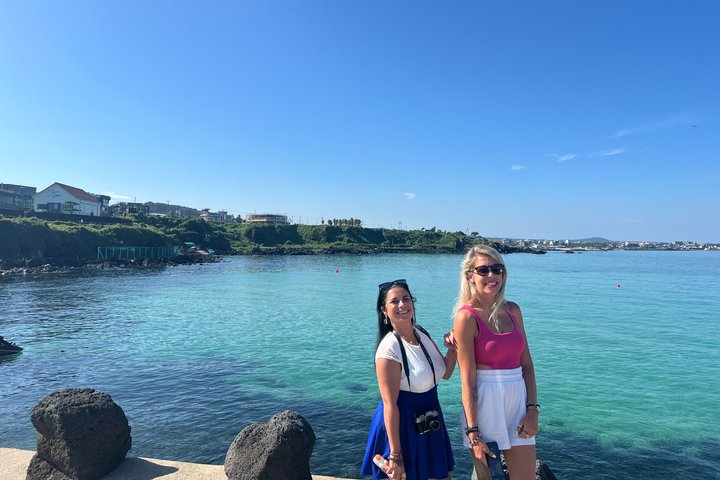
This tour is a must for first-time visitors to Jeju and will give you a first-hand experience of why the island has been designated a UNESCO Natural Heritage Site. As a private tour, the itinerary can be tailored to your own schedule. With detailed explanations from nationally certified guides, this tour will give you a broader understanding of Jeju. During the tour, I will tell you all about Jeju, its history and culture, as well as the hottest cafes and restaurants of the moment, and answer any questions you may have.
Inkluderet
Det er inkluderet
- Air-conditioned vehicle
- English certificated guide
Ikke inkluderet
- Lunch
- entrance fee
Rute
The small hill, Seobong, offers a bird's eye view of Jeju's most beautiful beach, Hamdeok Beach, and is not too steep, so anyone can reach the top in 20 minutes.
Manjanggul is a partially multi-level lava tube cave with a total length of 7.4 kilometers. The main passage is one of the largest in the world, with a width of 18 meters and a height of 23 meters. There are many lava tubes around the world, but few are as old as Manjang Cave, which is hundreds of thousands of years old and has a well-preserved internal form and topography, making it of great scientific and conservation value. the 7.6-metre-high stalagmite column at the end of the 1km opening is considered to be the largest in the world.
Seongsan Ilchulbong, 180 metres high, is a tuff cone formed by aqueous volcanic activity in a shallow sea about 5,000 years ago. When hot magma and water from underground met and reacted violently, the ash from the eruption piled up and formed Ilchulbong. It was once called Seongsan because it resembled a giant castle, and is now called Seongsan Ilchul Peak because of its beautiful sunrise view.
Gwangchigi beach (Pass by) A beach with a panoramic view of Seongsan Sunrise Peak
The word 'sari-ni' means 'sacred forest' or 'to wrap a thread in a circle so that it doesn't scatter', and a walk through the forest will leave you feeling enveloped in the refreshing scent of cedar.
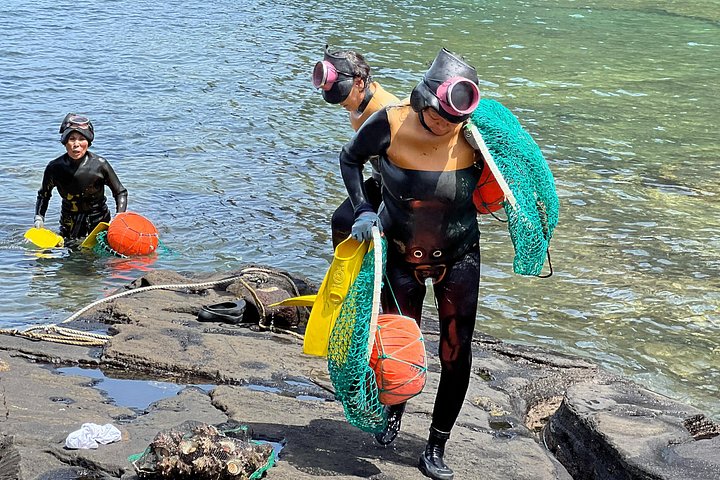
The museum focuses on Jeju's haenyeo culture, which has a history dating back to prehistoric times, and displays materials on the ocean, fishing villages, folklore, and fishing. The exhibits inside and outside the museum were donated by the haenyeo themselves. An actual haenyeo house was also donated and moved into the museum, and the food culture and life of a haenyeo are displayed in detail. The 7-minute film is a must-see.
Afbestilling
Gratis afbestilling indtil 24 timer før oplevelsen starter, med fuld refusion.
Anmeldelser
5,0
- 53
- 40
- 30
- 20
- 10
Bedømmelserne kommer fra 3 anmeldelser, som vores bookingpartner har indsamlet. Det er de rejsendes egne ord, i den rækkefølge de blev skrevet — aldrig omrokeret for at pynte på oplevelsen.
Godt at vide
- Afhentning
- Afhentning er inkluderet for alle.
- Billettype
- Mobile or paper ticket accepted
- Udføres af
- 김찬
- Public transportation options are available nearby
- Not recommended for travelers with spinal injuries
- Not recommended for pregnant travelers
- Not recommended for travelers with poor cardiovascular health
- Travelers should have at least a moderate level of physical fitness
How it compares in Seogwipo
- Its from-price is 171% above the median of the 46 dagsture we list in Seogwipo.
- Its length is typical for the group.
- By number of reviews it ranks 18 of 46.
- The operator lists free cancellation on it.
About Seogwipo
Seogwipo is the southern city of South Korea's Jeju Island, with waterfalls that drop to the sea, volcanic cliffs and tangerine orchards.
Seogwipo lies on the south coast of Jeju, a volcanic island off the southern tip of the Korean peninsula, where Mount Halla, South Korea's highest peak at 1,947 metres, rises over the island's centre. The city is built around a small harbour on a mild, green coast, with a covered market at Maeil Olle and a street named for the painter Lee Jung-seob, who lived here in the 1950s. Fishing boats and the haenyeo, women divers who gather seafood without air tanks, are part of local life.
Top-ranked sights in Seogwipo: Seongsan Ilchulbong (Sunrise Peak), O’Sulloc Tea Museum, Jeongbang Waterfall.