25% rabatGratis afbestilling
Beskrivelserne vises på engelsk.
Explore the ancient wonders of Egypt on our exceptional Day Tour to Luxor from Hurghada. Throughout the day, you will be treated to a hassle-free experience with all transfers carried out in an air-conditioned vehicle. Our knowledgeable tour guide will lead you through the fascinating historical sites of Luxor, including the Valley of the Kings and the iconic Karnak Temple. Enjoy a delicious lunch and stay hydrated with complimentary bottled water provided. Rest assured, all services charges and taxes are included, as well as entrance fees to the attractions. Immerse yourself in the glory of ancient Egypt with this unforgettable day trip.
At 5:00 am Pickup from your Hotel in Hurghada by Tour guide then you will be transferred to Luxor by Private A/C Vehicle to the West Bank where you will visit the Valley Of The Kings, the magnificence of the grandeur of architecture which was used for burial, there are many kings buried in this valley.
The rulers of the Eighteenth, Nineteenth, and Twentieth Dynasties of Egypt’s prosperous New Kingdom (c.1550–1069 BC) were buried in a desolate dry river valley across the river from the ancient city of Thebes (modern Luxor), hence its modern name of the Valley of the Kings. This moniker is not entirely accurate, however, since some members of the royal family aside from the king were buried here as well, as were a few non-royal, albeit very high-ranking, individuals. The Valley of the Kings is divided into the East and West Valleys. The eastern is by far the more iconic of the two, as the western valley contains only a handful of tombs. In all, the Valley of the Kings includes over sixty tombs and an additional twenty unfinished ones that are little more than pits.
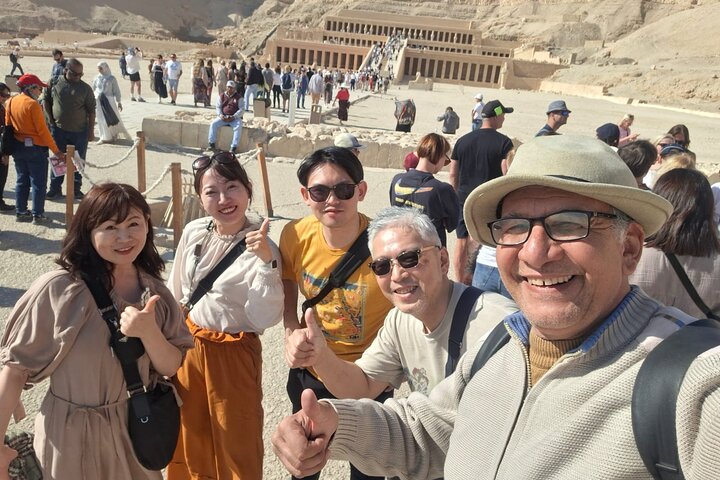
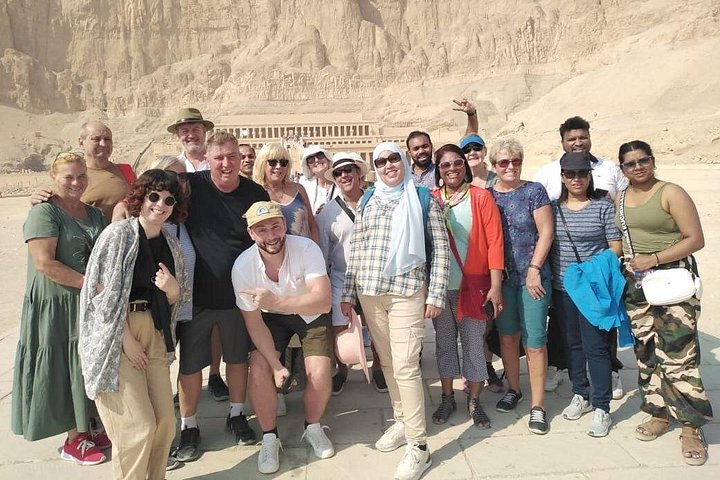
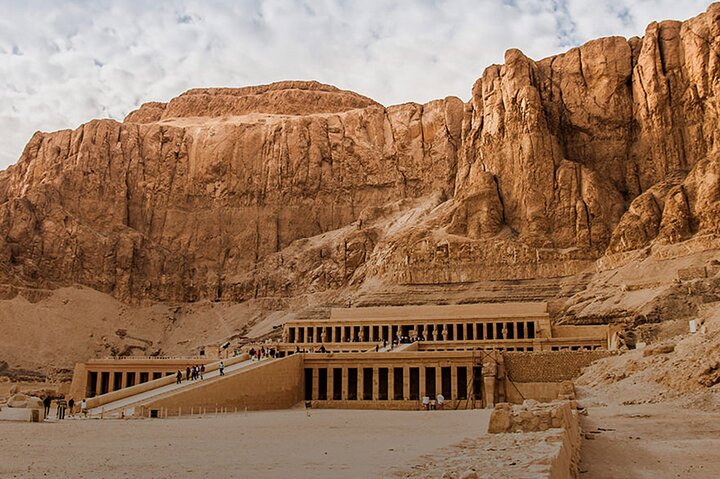
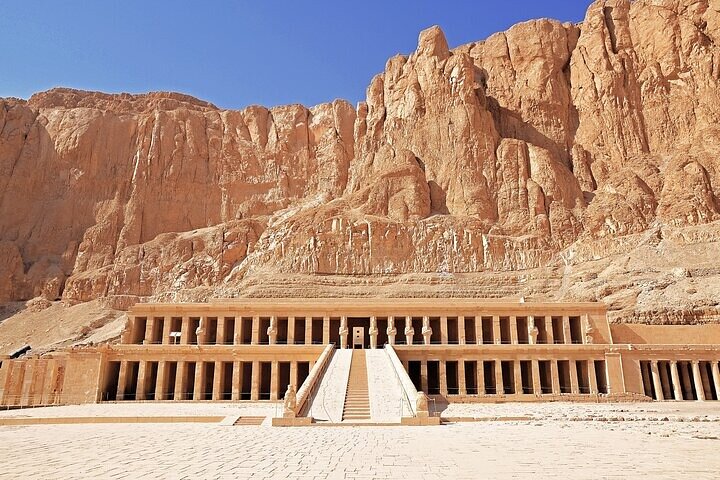
The celebrated temple of Hatshepsut (c.1473–1458 BC), the queen who became pharaoh, is located here, in Deir al-Bahari, on the west bank of Luxor. Composed of three man-made terraces that gradually rise up toward the sheer cliff face, this structure is truly a sight to behold. The site of Deir al-Bahari was sacred to Hathor, the goddess who nursed and reared every king, including their mythological ancestor, the god Horus, in Egypt’s primordial past. A manifestation of this goddess was believed to reside in the very hills under whose shadow lies the temple of Hatshepsut, and just on the other side of which is the site of the tombs of some of ancient Egypt’s most famous rulers, the Valley of the Kings. Stelae bearing prayers to Hathor depict her, in cow form, emerging from these mountains. This impressive geological formation features a summit that is naturally pyramid-shaped.
The Colossi of Memnon (Arabic: el-Colossat or es-Salamat) are two massive stone statues of the Pharaoh Amenhotep III, which stand at the front of the ruined Mortuary Temple of Amenhotep III, the largest temple in the Theban Necropolis. They have stood since 1350 BC, and were well known to ancient Greeks and Romans, as well as early modern travelers and Egyptologists. The statues contain 107 Roman-era inscriptions in Greek and Latin, dated to between AD 20 and 250; many of these inscriptions on the northernmost statue make reference to the Greek mythological king Memnon, whom the statue was then – erroneously – thought to represent. Scholars have debated how the identification of the northern colossus as "Memnon" is connected to the Greek name for the entire Theban Necropolis as the Muononium
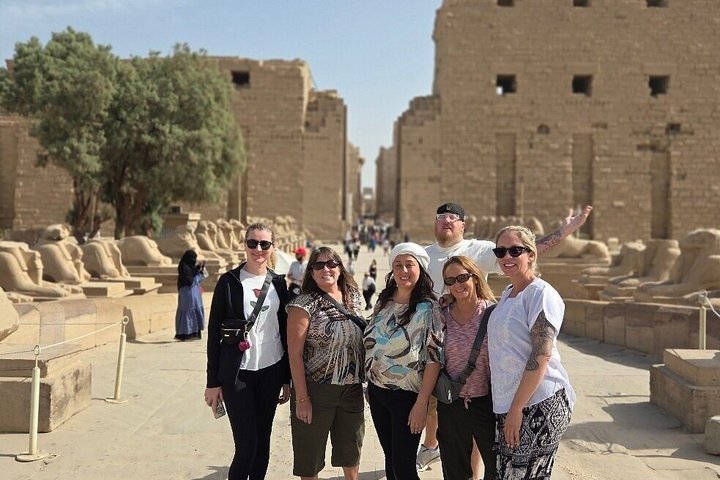
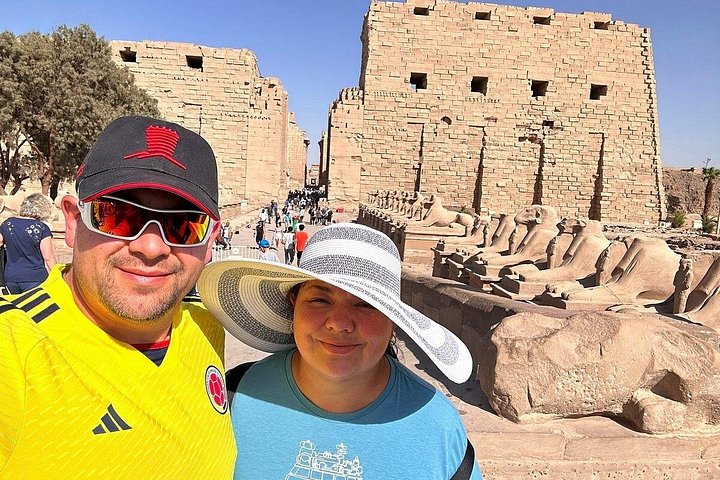
The Karnak Temple Complex, commonly known as Karnak (/ˈkɑːr.næk/), comprises a vast mix of temples, pylons, chapels, and other buildings near Luxor, Egypt. Construction at the complex began during the reign of Senusret I (reigned 1971–1926 BCE) in the Middle Kingdom (c. 2000–1700 BCE) and continued into the Ptolemaic Kingdom (305–30 BCE), although most of the extant buildings date from the New Kingdom. The area around Karnak was the ancient Egyptian Ipet-isut ("The Most Selected of Places") and the main place of worship of the 18th Dynastic Theban Triad, with the god Amun as its head. It is part of the monumental city of Thebes, and in 1979 it was added to the UNESCO World Heritage List along with the rest of the city. The Karnak complex gives its name to the nearby, and partly surrounded, modern village of El-Karnak, 2.5 kilometers (1.6 miles) north of Luxor.
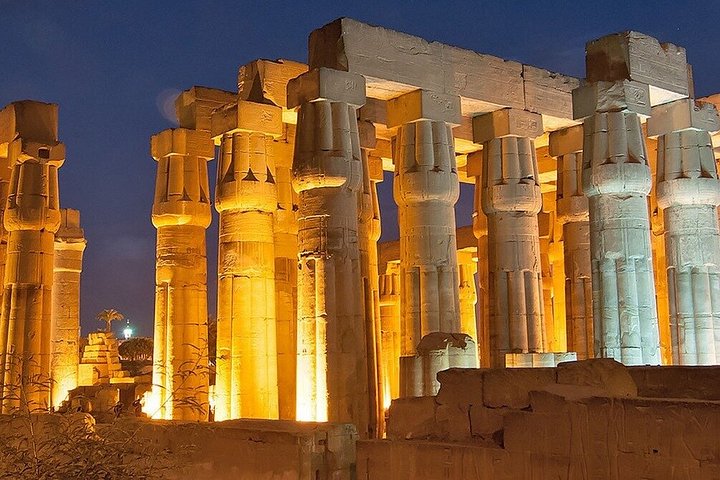
Luxor Temple, Ipet-resyt “Southern Sanctuary” to the ancient Egyptians, was so called because of its location within ancient Thebes (modern Luxor). It is located around three kilometers to the south of Karnak Temple, to which it was once linked with a processional way bordered with sphinxes. The oldest evidence for this temple dates to the Eighteenth Dynasty (c.1550–1295 BC). Ipet-resyt, unlike most other ancient Egyptian temples, is not laid out on an east-west axis, but is oriented towards Karnak. This is because Luxor Temple was the main venue for one the most important of ancient Egyptian religious celebrations, when the cult images of Amun, his wife Mut, and their son, the lunar god Khonsu, were taken from their temples in Karnak, and transported in a grand procession to Luxor Temple so they could visit the god that resides there, Amenemopet. This was the Opet Festival.
Later you will be driven back to your hotel in Hurghada
Gratis afbestilling indtil 24 timer før oplevelsen starter, med fuld refusion.
Hurghada er en badeby ved Det Røde Hav på Egyptens fastlandskyst, elsket for koralrev, varmt vand, ørkenudflugter og nemme badedage.
Byen strækker sig langs kysten, fra det ældre kvarter El Dahar med sin souk og fiskemarked til marinaen ved Sakkala og resortstrimlen mod syd. Ud for kysten vrimler Det Røde Havs rev og øer med farverige fisk og koralhaver, og af og til ses delfiner, hvilket gør snorkling og dykning til de vigtigste attraktioner.
Top-ranked sights in Hurghada: Giftun Islands, Hurghada Marina, Careless Reef.
Før/nu-priser kommer fra udbyderen, aldrig fra os.

fra230 US$184 US$
fra450 US$360 US$
Føj Ticket Hall til din hjemmeskærm
Billetter og byguider, ét tryk væk, også offline.
Ticket Hall