Aruba Open-Air Bus Sightseeing Tour with Local Beer & Sodas
Beskrivelserne vises på engelsk.
- 3 timer
- Gratis afbestilling indtil 24 t før
- 3 sprog
- Straks bekræftet
Højdepunkter
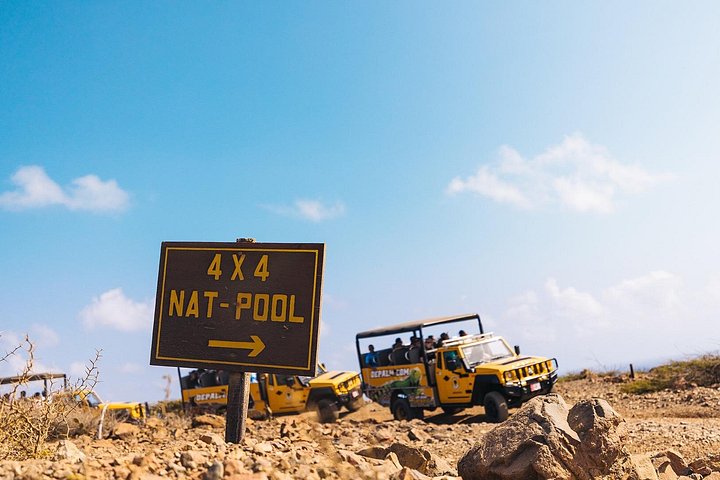
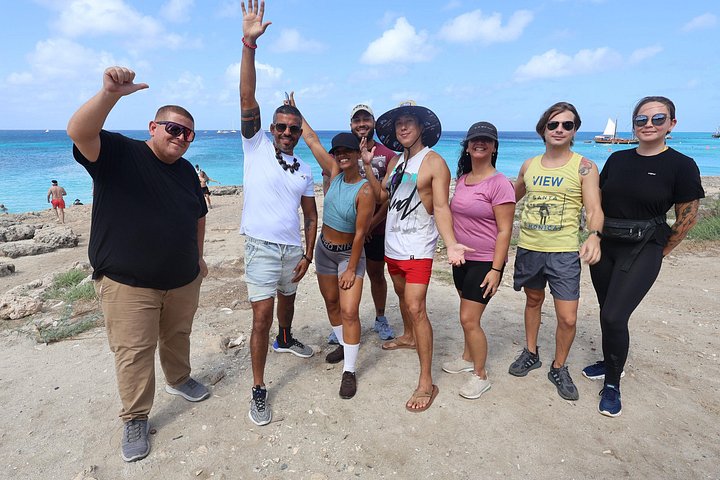
The Ultimate Daytime Island Exploration: Culture, History, and Nature. Turn your weekend into an exciting, shared journey with Cjam Adventures’ Open-Air Island Tour. Accommodating lively groups of up to 40 guests, our classic open-air bus features a dedicated tour guide sharing Aruba’s deep history and vibrant culture, along with a professional driver safely navigating you through the island's most captivating natural landmarks. This curated 3-hour experience bypasses the standard beach stops to focus purely on the authentic heritage and breathtaking landscapes of Aruba. As you cruise and mingle in the refreshing Caribbean breeze, you will enjoy a continuous selection of complimentary refreshments, including ice-cold local beers, soda, and water. Because we operate exclusively on Friday and Saturday, you are guaranteed to experience the island at its absolute best. We offer seamless door-to-door pickup and drop-off directly from your resort, Airbnb, villa, or the cruise ship terminal.
Inkluderet
Det er inkluderet
- ✅ Dedicated Local Tour Guide & Professional Driver •
- ✅ Complimentary Ice-Cold Balashi & Chill Local Beers (Must be 18+)
- ✅ Pickup and drop-off from hotel, Airbnb, Condominium and Cruise Ship Terminal
- ✅ Chilled Coca-Cola & Soft Drinks • ✅ Unlimited Ice-Cold Bottled Water •
Ikke inkluderet
- Gratitude
Rute
The Story • The Gold Rush (1824): A young sheep herder discovered gold on the island, prompting a British mining corporation to construct this massive limestone mill in 1872. • The Fortress: It was built without mortar, using heavy stones to withstand powerful coastal winds, protect millions in gold from pirates, and house the intense heat of smelting furnaces. • The Abandonment (1899): High operating costs and a decline in gold quality forced the mill to shut down after just over a decade, leaving it abandoned. The Ruins Today Today, the site is a free, open-air tourist attraction where no mining takes place. Instead, visitors use it for: • Exploration & Photo Ops: Tourists freely climb the historic stone walls to take photos against the backdrop of crashing ocean waves. • Tour Stops: It serves as a primary destination for guided ATV, Buses ,Utv Jeeps excursions exploring the rugged northern coast.
Millions of years ago, intense tectonic activity and volcanic forces deep underwater pushed these giant tonalite structures upward. Over millennia, wind and rain carved them into unique, random shapes that today resemble modern things like a "Dragon's Mouth". Because the rest of Aruba is relatively flat, geologists still debate the exact anomaly that left these multi-ton rocks stacked like a giant puzzle. Long before European settlers arrived, the indigenous Arawak (Caquetio) people considered Casibari a deeply sacred site. They used the natural cave-like shelters formed by the rocks for religious ceremonies, protection, and keeping watch over the island. Today, it is a preserved historic site with walking paths and stairs where visitors can climb to the top for a 360-degree view of Aruba.
Over thousands of years, the relentless pounding of the Atlantic Ocean waves and fierce trade winds carved out a massive arch from the ancient coral limestone cliffs along Aruba’s rugged northern coast. At its peak, it stood 25 feet (7.6 meters) high and stretched 100 feet (30 meters) long. • The Glory Days: It became Aruba's unofficial symbol and most-photographed landmark. For decades, millions of tourists and locals walked across it, snapped photos, and visited the local beachside snack shop. • The Collapse: Early in the morning on September 2, 2005, the bridge unexpectedly collapsed into the sea. Centuries of natural erosion from the waves had finally hollowed out the limestone structure to a point where it could no longer support its own weight. Today, the site is still heavily visited. People travel there to see the dramatic ruins of the original giant arch and to walk across the intact, smaller "Baby Bridge" right next to it.
The California Lighthouse, located on the northwestern tip of Aruba in an area called Hudishibana, was born out of a maritime tragedy. Contrary to popular belief, it is not named after the U.S. state, but rather after the S.S. California, a British steamship that tragically hit the rocks and sank off Aruba’s dark, rugged northern coast on September 23, 1891. Because there was no warning light to safely guide ships around the dangerous reefs at the time, the wreck became a major wake-up call for the island. Decades later, a French architect designed the stone tower to prevent future disasters. It was built between 1914 and 1916, though World War I delayed its French-manufactured lens from arriving until it was finally lit around 1918. Today, it stands 30 meters (98 feet) tall as Aruba's highest structure, serving as a beautiful historic monument where visitors can climb to the top for unmatched 360-degree views of the island's coastline.
Oranjestad began as a small, informal fishing and smuggling village known as Playa in the late 18th century. The town truly took shape in 1796 when the Dutch began building Fort Zoutman to protect the harbor from pirates. Traders quickly moved to the area, and in 1824, the town was officially named Oranjestad after King William I of the House of Orange-Nassau, following the discovery of gold on the island. For centuries, its history shifted through the Arawak indigenous era, Spanish exploration, and Dutch colonization. In the 20th century, a massive oil refinery boom nearby modernized the region. When the refinery slowed down in the 1980s, the city pivoted completely to tourism. Today, Oranjestad serves as the vibrant capital of Aruba, famous for blending pastel-colored Dutch colonial architecture with a lively Caribbean flair.
Afbestilling
Gratis afbestilling indtil 24 timer før oplevelsen starter, med fuld refusion.
Godt at vide
- Afhentning
- Afhentning er inkluderet for alle.
- Billettype
- Mobile or paper ticket accepted
- Gruppestørrelse
- Op til 40 rejsende
- Udføres af
- Cjam Adventures Aruba
- Not recommended for travelers with spinal injuries
- Not recommended for pregnant travelers
- Not recommended for travelers with poor cardiovascular health
- Suitable for all physical fitness levels
How it compares in Palm - Eagle Beach
- Its from-price is 45% below the median of the 167 experiences we list in Palm - Eagle Beach.
- Its length is typical for the group.
- The operator lists free cancellation on it.
About Palm - Eagle Beach
Palm Beach and Eagle Beach are Aruba's two main beach strips, with high-rise resorts to the north and low-rise hotels along wider, calmer sand.
Palm Beach and Eagle Beach run in a line along Aruba's west coast, a short way north-west of Oranjestad, and between them they hold most of the island's resorts. Palm Beach is the livelier of the two, with tall hotels, water-sports stands, restaurants and casinos behind the sand. Eagle Beach is wider and calmer, backed by low-rise hotels and dotted with trees bent by the steady wind.
Særtilbud i Palm - Eagle Beach
Før/nu-priser kommer fra udbyderen, aldrig fra os.