خصم 10%إلغاء مجاني
Complete Douro Valley Wine Tour with Lunch, Wine Tastings and River Cruise
ابتداءً من113 US$102 US$
الأوصاف معروضة بالإنجليزية.
The Minho region, where the cities of Guimarães and Braga are located, owes its recognition, importance and name to the Minho River, one of the four largest rivers in Portugal. Embraced by an extensive and verdant natural area, we are presented by the famous Green Wine that creates a symbiosis as special as the grooves from which the nectar comes. Also, we can’t ignore the fact that it was in this location that the Portuguese County was created.
The Castle of Guimarães (Portuguese: Castelo de Guimarães), is the principal medieval castle in the municipality Guimarães, in the northern region of Portugal. It was built under the orders of Mumadona Dias in the 10th century to defend the monastery from attacks by Moors and Norsemen. The castle is a military fortification grounded primarily in the late Romanesque period, and elaborated during the early Gothic epoch of Portuguese architecture. Its area is delineated by walls forming a pentagram, similar to a shield, that includes eight rectangular towers, military square and central keep. Originating in the foundations of a Roman structure, from the writings of Alfredo Guimarães, it was later elaborated on the French model, in its current the form of a shield, with reduced central yard and difficult accesses. It includes several Gothic characteristics, owing to its remodelling at the end of the 13th century, when the keep and residences were constructed (possibly over pre-existing structures).
The Palace of the Dukes of Braganza (Portuguese: Paço dos Duques de Bragança) is a medieval estate and former residence of the first Dukes of Braganza, located in the historical centre of Guimarães (Oliveira do Castelo), in the north-western part of Portugal. It was initiated between 1420 and 1422 by Afonso, Count of Barcelos, the illegitimate son of John I of Portugal (and future Duke of Bragança), after his marriage to his second wife. His prodigeny would occupy the space until the Dukes of Braganza moved to Vila Viçosa, abandoning the palace. The 16th Century marked the beginning of period of ruin, which was aggravated during the 19th century, when the local population used the palace as a personal quarry. During the Estado Novo regime, a controversial restoration restored the Palace, while implying a grandeur that may not have existed. The Palace of the Dukes was classified as a National Monument (Portuguese: Monumento Nacional) in 1910, and has been an official residence for the Presidency.
Historic Centre of Guimarães is an urban space of the city of Guimarães, in Portugal, tracing back to medieval age covering an area of 16 hectares and retaining many buildings from the medieval age until 19th century. Since 2001, it is declared as a World Heritage Site of UNESCO. Guimarães is closely linked to the formation of national identity and of Portuguese language in 12th century. It is the native city of Afonso Henriques, the first king of Portugal, who in 1139, declared independence of the country.
The Cathedral of Braga (Portuguese: Sé de Braga) is a Roman Catholic church in the northern city of Braga, Portugal. Due to its long history and artistic significance, it is also one of the most important buildings in the country. It is the seat of the Archdiocese of Braga and of the Primate Archbishop of Portugal. The Cathedral has been classified as National Monument since 1910.
Bom Jesus do Monte is a Portuguese sanctuary in Tenões, outside the city of Braga, in northern Portugal. Its name means Good Jesus of the Mount. The Sanctuary is a notable example of pilgrimage site with a monumental, Baroque stairway that climbs 116 meters (381 feet). It is an important tourist attraction of Braga.
The Shrine of Our Lady of Sameiro is one of the places most visited Marian cult in Portugal, attracting many devotees every year during pilgrimages from 1st Sunday of June and the last Sunday of August. Its construction was initiated in XIX century, by Father Martinho da Silva, in neoclassical style. Artistically not have much interest except the silver tabernacle that we can see on the main altar and the image of the patron saint, held in Rome by the sculptor Eugénio Maccagnani and brought to the sanctuary in 1880. But his visit is justified by the fact that we have here one of the most spacious panoramic Region, as the Shrine of Our Lady of Sameiro is 566 meters.
إلغاء مجاني حتى 24 ساعة قبل بدء التجربة، مع استرداد كامل.
5.0
التقييمات مبنية على 3 مراجعة جمعها شريك الحجز لدينا. وهي كلمات المسافرين أنفسهم بالترتيب الذي كُتبت به، ولا يُعاد ترتيبها لتجميل التجربة.
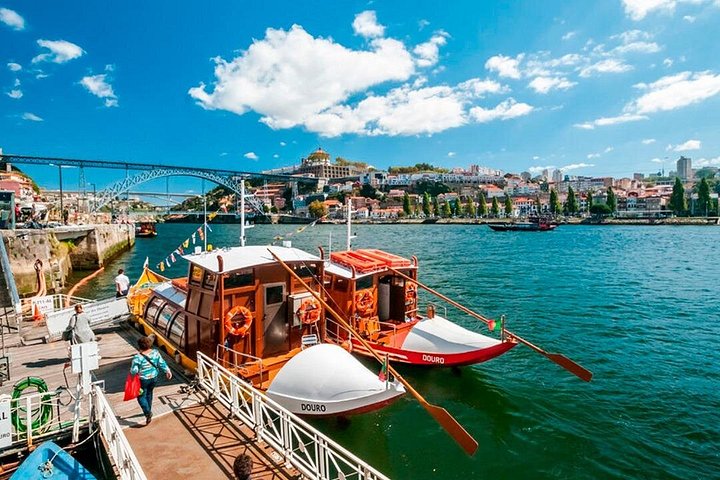
Porto tumbles down steep hills to the Douro River, a granite city of tiled churches, riverside cellars and port wine aged across the water.
The Ribeira district lines the riverbank with colourful houses, cafés and boats, part of a UNESCO-listed old centre beneath the iron arches of the Dom Luís I Bridge. Above it, the São Bento station hall is covered in blue-and-white azulejo tiles, the Clérigos Tower rises above the rooftops, and the Sé cathedral stands on its hill.
Top-ranked sights in Porto: Clérigos Church and Tower (Torre & Igreja dos Clérigos), Dom Luis Bridge (Ponte de Dom Luis I), Porto Cathedral (Sé Catedral do Porto).
السعر قبل الخصم وبعده من المشغّل، لا منّا.
ابتداءً من113 US$102 US$
ابتداءً من166 US$158 US$

ابتداءً من286 US$243 US$
ابتداءً من68 US$62 US$
ابتداءً من66 US$56 US$
ابتداءً من50 US$33 US$
ابتداءً من113 US$102 US$
ابتداءً من63 US$
أضف Ticket Hall إلى الشاشة الرئيسية
تذاكر وأدلة مدن على بُعد نقرة واحدة، حتى دون اتصال.
Ticket Hall