قد تنفد سريعًاخصم 5%
PompeiI Exclusive Tour with your Archaeologist in a Small Group
ابتداءً من29 US$27 US$
الأوصاف معروضة بالإنجليزية.
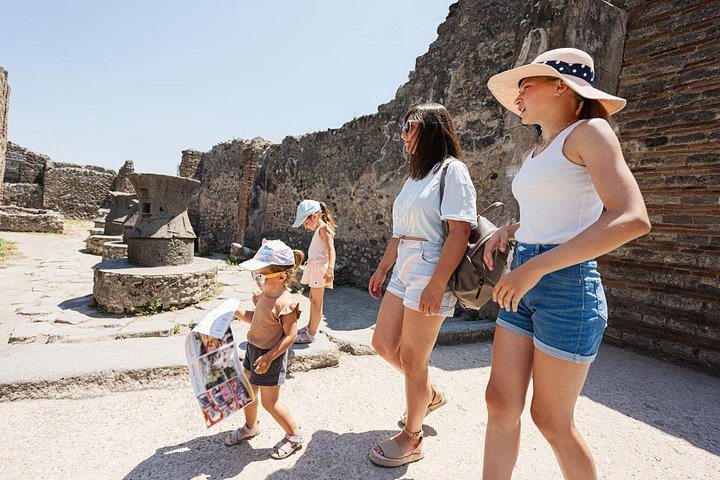
Explore the ancient ruins of the Pompeii Archaeological Park, UNESCO World Heritage Site. Enjoy this great walking tour, Skip-The-Line fast access tickets included. Discover the town buried by the eruption of Vesuvius in A.D. 79 and how it still offer an unparalleled window into the quotidian life of classical antiquity. Walk amongst the incredible ancient ruins as our friendly expert licensed tour guide tells you of the glory and the drama of Pompeii: • Sanctuary of Venus • Basilica • Forum • Temple of Apollo • Macellum • House of Faun • Temple of Jupiter • Lupanar • House of Menander • Stabian Baths • Large Theatre • Small Theatre Odeon Skip-The-Line Tickets with fast access included.
Make your way to the Pompeii excavation on your own (it's an easy trip from Naples or Sorrento on the Circumvesuviana train to the Pompei Scavi station). Meet your guide, with a sign with our company's name "ItalyBestExcursions" on the top, at the main entrance "Porta Marina" directly across the road from the Pompeii Scavi train station. • Please meet the guide at least approx. 15 minutes in advance, entrance is strictly limited.
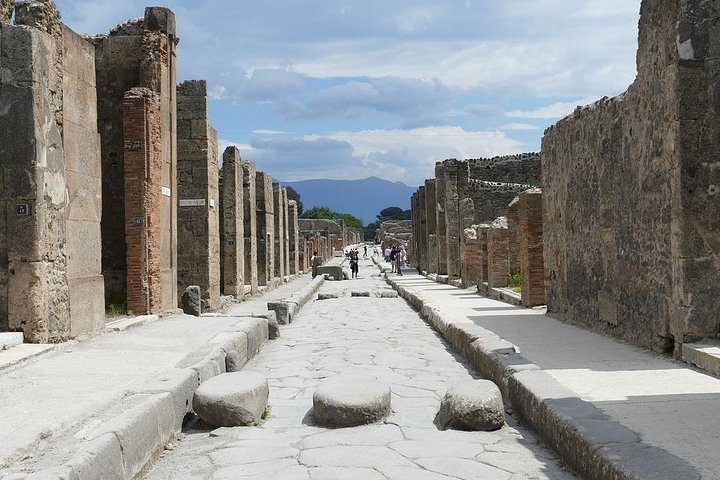
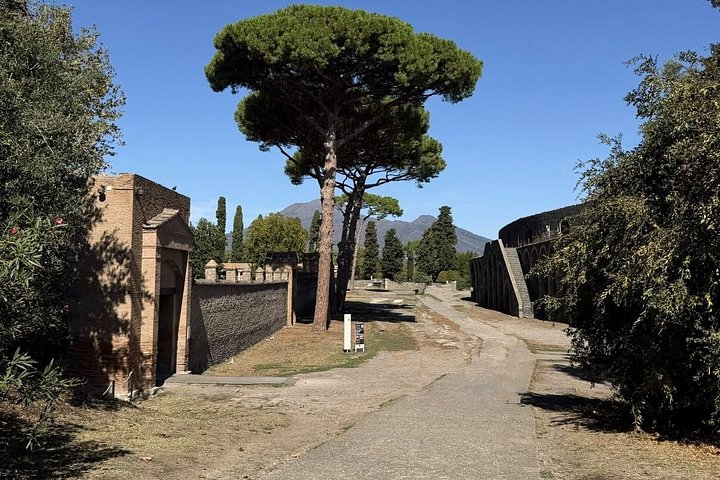
Visiting Pompeii (Skip-The-Line Tickets included) is not like a museum , is as live again in an ancient roman commercial town of 3 Km. Buildings, temples, shops catched in the time of the eruption. Pompeii was an ancient Roman town near modern Naples, it was mostly destroyed and buried under 4 to 6 m (13 to 20 ft) of volcanic ash and pumice in the eruption of Mount Vesuvius in 79 AD.
The Sanctuary of Venus is placed on spectacular artificial terrace that offers great views of the Gulf of Naples, overlooking the bay where the harbour was to be situated. Venus was the patron goddess of Pompeii, to whom the colony was named upon conclusion (80 BC).
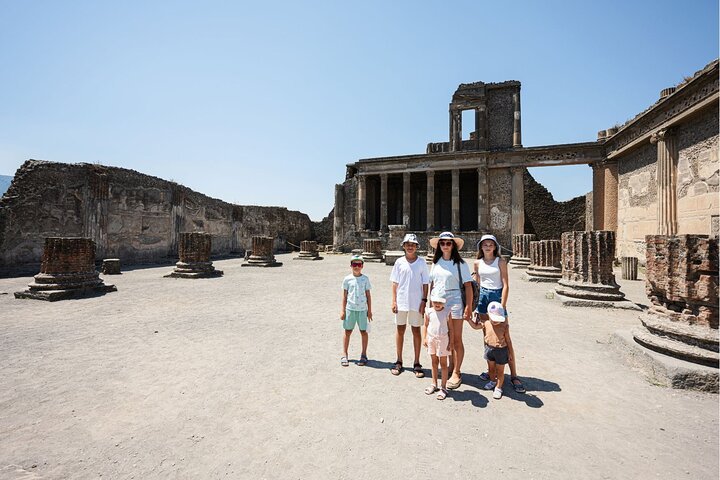
The Basilica, with its extension of 1,500 square metres, was the most sumptuous building in Pompeii, it is dated back to 130-120 BC and is one of the oldest examples of this type of building in the entire Roman world.
The Pompeii Civil Forum is the core of daily life of the city and is the focal point of all the main public buildings for city administration and justice, business management, and trade activities such as markets, as well as the main places of citizen worship.
The Sanctuary of Apollo is one of the oldest places of worship in Pompeii, built in a strategic point, along the path that goes up to Marina Gate, which led to the public heart of the city.
The Macellum consists of a tuff quadriporticus with a hall for worship in an elevated position on the eastern side, in line with the entrance. The copies of two marble statues, a female and a male armed, are found on the niches of the side wall, together with the fragment of a larger statue, probably pertaining to an emperor, Titus or Vespasian, indicating how this area was intended for the imperial cult.
It is one of the larger houses of Pompeii, covering an entire block of about 3000 sqm and, according to its original layout, it dates back to the 2nd century BC. The wealth and social level of the owner are immediately evident from the street: the pavement bears the Latin welcome inscription (HAVE)
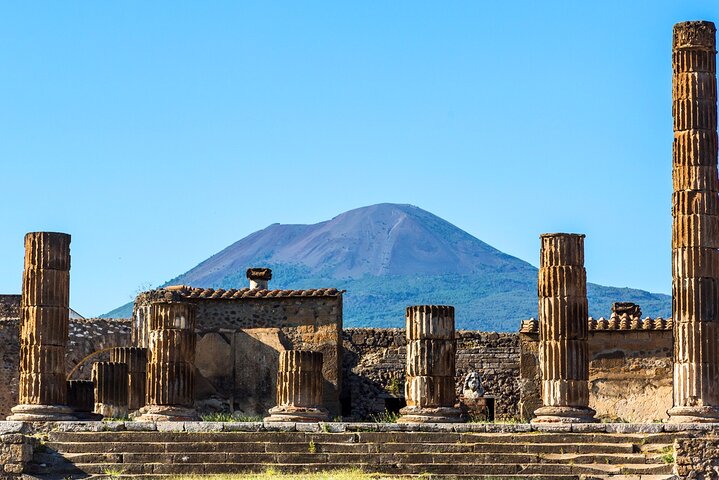
The Temple of Jupiter dominates the north side of the Forum, with Mount Vesuvius scenically rising behind. When the colony was founded (80 BC).
The lupanar was the official brothel of Pompeii. As a trading town, it was visited every day by large numbers of people, especially traders from other towns.The prostitutes in the brothel were mostly Greek and Oriental slaves who were paid between two and eight Asses (a glass of wine cost one Ass) for their services. Small paintings with erotic depictions on the walls of the central corridor informed customers of the activities that took place within the Lupanare. The brothel is named from lupa, a Latin word meaning 'prostitute'.
The atrium has frescoes with scenes from the Iliad and the Odyssey. The peristyle is rhodium-shaped, with the north side higher. The house owes its name to a picture of Menander, an Athenian playwriter, placed in the portico.
The main entrance on via dell'Abbondanza leads to a large courtyard. The pool is found to the left, whereas a colonnade is found to the right, which leads to the men's quarters, which are split into the apodyterium (dressing room), with the frigidarium (for cold baths), which leads to the tepidarium (for medium temperature baths) and then to the calidarium (for hot baths).
All sales are final. No refund is available for cancellations.
Pompeii is a Roman town near Naples frozen in ash when Mount Vesuvius erupted in AD 79, with streets, villas and frescoes preserved beneath the volcano.
Pompeii was a thriving Roman town when Vesuvius buried it under ash and pumice in AD 79. Excavation, begun in the eighteenth century, has uncovered paved streets with stepping stones, shops, bakeries, bathhouses and the forum. The amphitheatre, among the oldest Roman ones to survive, and the grand House of the Faun show the range of life, and plaster casts of the dead record the final moments of some residents.
Top-ranked sights in Pompeii: Pompeii Archaeological Site, Stabian Baths (Terme Stabiane), Via dell’Abbondanza.
السعر قبل الخصم وبعده من المشغّل، لا منّا.
ابتداءً من29 US$27 US$
ابتداءً من184 US$166 US$
أضف Ticket Hall إلى الشاشة الرئيسية
تذاكر وأدلة مدن على بُعد نقرة واحدة، حتى دون اتصال.
Ticket Hall