Saigon Discovery Private Tour Shore Excursion from Saigon Port
描述以英文顯示。
- 4 小時 30 分
- 開始前 24 小時可免費取消
- 英文導覽
- 即時確認
亮點
Ho Chi Minh City, also known as Saigon and long considered as the Pearl of the Far East, is the most dizzying city of commerce and culture in Vietnam. A visit to Saigon is like an encounter with exotic delicious food, French colonial architecture and memories of Vietnam War. A state-run handicraft enterprise exports a wide range of products—including furniture, carpets, lacquer paintings, and other works of art—made largely from local materials and you will be shown a part of this attraction. There are so many amazing attractions and you will have a chance to discover apart of those such as War Remnants Museum to learn more about Vietnam War, Jade Emperor Pagoda to learn more about a part of Vietnamese culture. Saigon Central Post Office is known as Center of Telegraph in Indochina War or exploration the National Monument of Reunification Palace; Ho Chi Minh City Museum is to learn about Trading Centre of South Vietnam.
費用包含
包含項目
- Bottled water
- All entrance fees
- Air-conditioned vehicle
- English speaking tour guide
- Picking up & dropping off at Saigon Port No.05 Nguyen Tat Thanh street, district 4
不包含
- Tipping/ gratuities, personal expenses
行程
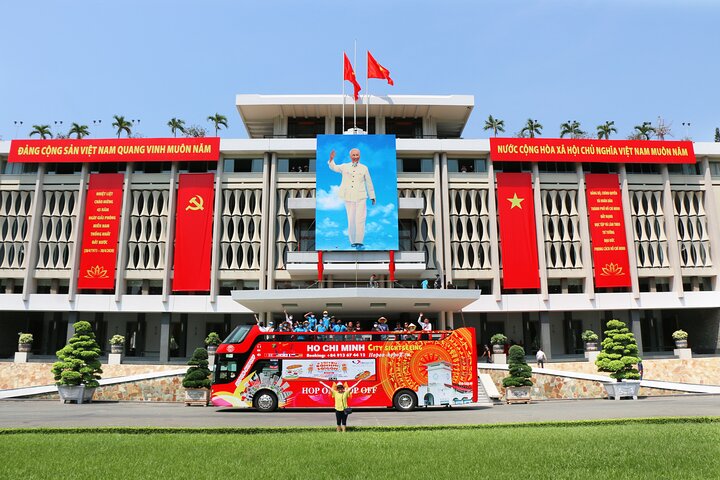
Surrounded by royal palm trees, the dissonant 1960s architecture of this landmark government building and the eerie ambience of its deserted halls make it an intriguing spectacle. The first Communist tanks to arrive in Saigon rumbled here on 30 April 1975 and it’s as if time has stood still since then. The building is deeply associated with the fall of the city in 1975, yet it's the kitsch detailing and period motifs that steal the show. It's also known as the Independence Palace. The building was named Independence Palace and was home to the succeeding South Vietnamese president, Nguyen Van Thieu, until his hasty departure in 1975. Designed by Paris-trained Vietnamese architect Ngo Viet Thu, it is an outstanding example of 1960s architecture, with an airy and open atmosphere. The Reunification Palace, also known as Independence Palace, is a landmark building located in the heart of Ho Chi Minh City. And it is known as a must see National Monument once you are in Ho Chi Minh City.
A grand neoclassical structure built in 1885 and once known as Gia Long Palace, HCMC’s city museum is a singularly beautiful and impressive building, telling the story of the city through archaeological artefacts, ceramics, old city maps and displays on the marriage traditions of its various ethnicities. The struggle for independence is extensively covered, with most of the upper floor devoted to it. Deep beneath the building is a network of reinforced concrete bunkers and fortified corridors. The system, branches of which stretch all the way to Reunification Palace, included living areas, a kitchen and a large meeting hall. In 1963 President Diem and his brother hid here before fleeing to Cha Tam Church. The network is not opened to the public because most of the tunnels are flooded. In the gardens are various pieces of military hardware, including the American-built F-5E jet used by a renegade South Vietnamese pilot to bomb the Reunification Palace on 8 April 1975.
The city's landmark French-era post office is a period classic, designed by Marie-Alfred Foulhoux (though often credited to Gustave Eiffel) and built between 1886 and 1891. A mosaic of Ho Chi Minh takes pride of place at the end of its barrel-vaulted hall. The post office features a unique, bright yellow exterior framed with white trim. Curved windows are elegantly framed with green shutters and a large clock is featured prominently at the building’s main entrance. The stunning, spacious interior has tall, domed ceilings with metal arches and a gorgeous patterned tile floor. There are two painted maps inside the office – Lignes télégraphiques du Sud Vietnamet du Cambodge 1892 (Telegraphic lines of southern Vietnam and Cambodia 1892) depicts the postal route from southern Vietnam to Cambodia, and on the right side of the building is Saigon et ses environs, 1892 (Saigon and its surroundings), a local map.
The lacquer itself is actually the resin of a tree which is mixed with coloured pigments and solvents and applied layer after layer to the object's surface, producing a shiny and durable finish. Eggshell and mother of pearl may be applied to the surface before the lacquer is applied, in which the finished product is sanded down to reveal the decoration beneath. The high quality of resin from Vietnamese lacquer trees, notably those of Phu Tho, was a crucial factor in the rapid development of this art form during the feudal period. Decorated lacquer statues, panels, boxes and trays (1428-1527), may still be seen at many temples and pagodas. In subsequent centuries the use of lacquerware was extended to larger items such as wooden chairs and tables. Since that time lacquerware has continued to develop into one of the mainstays of the Vietnamese handicraft industry, both at home and abroad. Today's most popular items include vases, jewel cases, desk sets, trays and vertical blinds.
Founded on September 4, 1975, The War Remnants Museum is a member of the International Network of Museums for Peace (INMP) and the International Council of Museums (ICOM). It is the unique museum in Vietnam to systematically study, collect, conserve and display exhibits on war crimes and consequences inflicted on the Vietnamese people by foreign aggressive forces. Simultaneously, the Museum appeals to everybody to oppose unjust wars, preserve global peace, promote friendship and solidarity among nations. The Museum is endowed with 9 permanent thematic exhibitions and various special collections. All year round, a wide range of activities are organized, including conferences, meetings with war witnesses, temporary and itinerant exhibitions. With nearly one million domestic and international visitors per year, The War Remnants Museum is one of Ho Chi Minh City's most enticing cultural and tourist sites.
Built in 1909 in honour of the supreme Jade Emperor (King of Heaven), this is one of the most atmospheric temples in Ho Chi Minh City, stuffed with statues of phantasmal divinities and grotesque heroes. The pungent smoke of incense fills the air, obscuring the exquisite woodcarvings. Its roof is encrusted with elaborate tile work, and the temple's statues, depicting characters from both Buddhist and Taoist lore, are made from reinforced papier mâché. The multifaith nature of the temple is echoed in the shrine's alternative name Phuoc Hai Tu, whose message is clearly Buddhist. Similarly, the Chinese character in the main temple hall mean 'The light of Buddha shines on all. Over 100 years old went by with many changes, Jade Emperor Pagoda remains the timeless charm. Its beauty is a harmonious combination among 3 main religions in the Orient: Taoism, Buddha, and Confucianism. Thanks to the impressive & unique beauty with sacred legend, this is one of the most wonderful destinations.
取消政策
體驗開始前 24 小時可免費取消,全額退款。
出發前須知
- 接送
- 所有人都含接送。
- 票種
- Mobile or paper ticket accepted
- 營運業者
- Saigon Jeep Tours From Local Travel Vietnam
- Infants are required to sit on an adult’s lap
- Suitable for all physical fitness levels
- Optional: $30 USD/ person for picking up in Hiep Phuoc JSC Port
- The remaining time is allotted for the travel time
How it compares in Ho Chi Minh City
- Its from-price is close to the median of the 2927 experiences we list in Ho Chi Minh City.
- It is shorter than most of them.
- The operator lists free cancellation on it.
About Ho Chi Minh City
Ho Chi Minh City, still widely called Saigon, is Vietnam's buzzing commercial hub of French colonial landmarks, war history and superb street food.
District 1 holds the main sights within walking distance: the red-brick Notre-Dame Cathedral, the elegant Central Post Office with its vaulted hall, the colonial Opera House and the ornate City Hall. The Independence Palace preserves its rooms as they were at the end of the war, and the War Remnants Museum tells the story of the conflict with sobering directness.
Top-ranked sights in Ho Chi Minh City: Cu Chi Tunnels, Saigon Opera House (Opéra de Saïgon), Saigon Central Post Office.
Ho Chi Minh City的特價優惠
原價與特價由業者提供,不是我們標的。