
Independent guide
Big Bus Munich: routes, stops and tickets
Independent guide, not operated by or affiliated with Big Bus Tours.
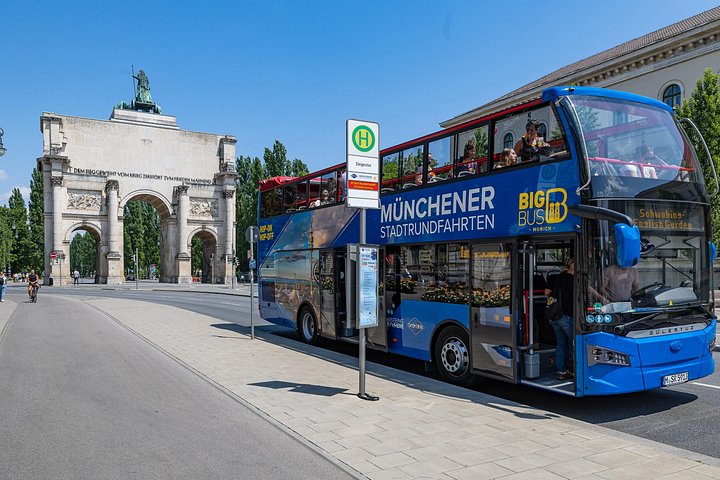
We list one Big Bus ticket option in Munich, from 1 hr. Big Bus Tours runs the Munich hop-on hop-off service as two colour-coded lines, Green for the centre and Orange for the outer sights. This guide covers 2 routes, its 9 distinct stops, when to ride and who it suits, then lines up the tickets.
- Routes2
- Stops9
- Shortest loop60M
- Ticket1
Route and stops
- Green Line
- Orange Line
Central Munich loop starting at Karlsplatz (Stachus) and covering Odeonsplatz, Marienplatz, Max-Joseph-Platz, the Eisbach by the English Garden and the Deutsches Museum. The seller pages name these stops but not their order, so the list below is not a running sequence.
Green Line
Longer line from Karlsplatz out to Nymphenburg Palace, then north to the Olympiapark and BMW Welt area and back towards the centre through Schwabing. Stop order is not given on the pages checked.
Orange Line
Big Bus tickets in Munich
Want to see every hop-on hop-off bus in Munich, not just this one? Compare hop-on hop-off tours in Munich.
What riders say
Across these tickets travellers rate Big Bus Munich 3.0 out of 5 from 67 reviews.
The big bus stops at all of the main attractions and the time between buses is just enough. Great drivers and the audio information is excellent
Great clean bus with audio guide. The top of the bus can be opened on a good day for open air viewing. The Green line took us all around the city and we got to see so many landmarks.
Made getting around Munich so easy, being able to hop on and hop off is such a good idea. Prices very reasonable. You have a choice of tours. We did all.
Best time to ride
Late spring to early autumn gives the best conditions for an open-top ride, and the Orange Line's palace and park stops are most pleasant in dry weather. Winter rides are possible but cold, so warm layers help.
Who it suits
- Families
- Olympiapark, Nymphenburg's gardens and the English Garden give children room to get off and run around between rides.
- Couples
- The Green Line links Marienplatz, Odeonsplatz and the Eisbach, while the Orange Line adds the palace gardens.
- Seniors
- Hop-on hop-off lets riders pick a few stops across a spread-out city. Check the operator for current accessibility details before booking.
- First-time visitors
- The Green Line, about an hour if you stay aboard, covers the central sights; the Orange Line adds the outer ones.
Tips before you go
- Karlsplatz (Stachus) is the main starting stop for both lines, though you can board at others.
- Seller pages describe buses roughly every 30 minutes on the Green Line, but the Orange Line is reported as less frequent on weekdays, so check the live timetable.
- Ticket types differ: some include only the Green Line, so confirm the Orange Line is covered before booking.
- Seller pages disagree on exact stop names and order, so use the operator's current map once you are in Munich.
Sights along the way
Marienplatz, Odeonsplatz, English Garden, Deutsches Museum, Nymphenburg Palace, Olympiapark, BMW Welt.
Top-ranked in Munich: Neuschwanstein Castle, Marienplatz, Odeonsplatz, Dachau Concentration Camp Memorial Site, Linderhof Palace. All things to do in Munich.
Why take the bus in Munich
The case for a sightseeing bus here is strongest for first-time visitors who want an overview and a way to reach the outer sights without working out tram and U-Bahn connections. Nymphenburg Palace lies to the west and the Olympic Park to the north, and a hop-on hop-off loop strings those together with the centre in one ticket decision. The open-top format also suits a city with broad avenues and big squares, where the architecture is best seen from a little above street level.
The case against is just as clear. The historic core is small enough to walk. Marienplatz, the Frauenkirche, Peterskirche, the Viktualienmarkt, the Residenz and Odeonsplatz all sit within a short stroll of each other, and wandering between them is more enjoyable than riding. If your plan is mostly the old town, a walking tour led by a local guide, typically a couple of hours with stories you will not get from a recorded commentary, may suit you better than a bus. The metro and trams are the better tool for point-to-point trips, such as reaching a beer garden or a museum you have already chosen.
So the sensible split is this: walk the centre, and use the bus for the outer ring and for a first orientation. Anyone with only one day in Munich gets the most from the bus. On two or three days, it can cover the spread-out sights on one day and leave the others free for the old town, a day trip or a long afternoon in the English Garden.
How the routes work together
There are two lines, and they do different jobs. The Green Line is the central loop. It takes in Karlsplatz (Stachus), Odeonsplatz, Marienplatz, Max-Joseph-Platz, the Eisbach by the English Garden and the Deutsches Museum. It is the shorter of the two, at about 1 hour if you stay on board, and it is the one that fits the sights people usually put at the top of a Munich list.
The Orange Line is the longer one, about 1 hour 20 minutes, and it heads outward. Think of it as the line for sights that are awkward to reach otherwise, rather than for the old town.
Karlsplatz (Stachus) is the shared stop, which makes it the natural place to switch between lines or begin. Pairing them makes sense for a full day; for a shorter visit, pick the line that matches your interests. Choose the Green Line for the old town and river, the Orange Line for palace gardens and the Olympic grounds.
One point on stops: the Green Line stop at Marienplatz is the most useful of all, since it puts you at the square itself, about 100 metres from Peterskirche and about 200 metres from both the Frauenkirche and the Viktualienmarkt. The Max-Joseph-Platz stop is about 100 metres from the Residenz, and the Hofgarten is about 300 metres from the Odeonsplatz stop. Those walking distances are why the central loop works best as a ride between clusters rather than a way to hop between neighbouring sights.
A sample day on the bus
This plan treats the bus as a way to reach the far-flung sights and walks the rest. It suits a single day, or a half-day with some trimming.
Start in the morning at Karlsplatz (Stachus) on the Orange Line and head for Nymphenburg Palace. Gardens like these are at their best before the day warms up, and the park has room for a long, unhurried walk. Re-board and continue to the Olympiapark and BMW Welt area. The Olympic Park recalls the 1972 Games and is a good place to stretch your legs; BMW Welt is the stop for anyone with an interest in cars. Staying aboard through Schwabing brings you back towards the centre.
In the afternoon, take the Green Line to Marienplatz. From here, put the bus aside. The whole central cluster can be done on foot: the New Town Hall and its Glockenspiel, Peterskirche, the Frauenkirche, a snack at the Viktualienmarkt, then the Residenz and Odeonsplatz with the Hofgarten beside it. That is plenty for an afternoon, and it is where lingering pays off.
If energy remains, rejoin the Green Line for the Eisbach and the English Garden, where surfers ride the standing wave, or for the Deutsches Museum on its island in the Isar. Pick one, not both: the museum alone can fill hours, and the garden rewards slow time. Anyone short on time should drop the Orange Line and spend the full day on the Green Line plus the walk.
Booking advice
Choose the ticket by what you want to see rather than by the headline duration. If your list is the old town, the river and the museum, a ticket covering the central loop is enough. If Nymphenburg and the Olympic Park matter to you, look closely at the ticket page to see whether the longer line is part of what you are buying, because not every ticket type covers both lines.
Two more things are worth reading before you buy: the languages offered for commentary, and the tour type. Which of these a given ticket offers is described on its page.
If you travel in colder months, factor in the open top and bring layers. If you are visiting with someone who needs step-free access, check accessibility details on the ticket page rather than assuming them. Finally, compare the listings side by side: the differences in line coverage and format are what separate one ticket from another.
Sights worth the stop
Marienplatz is the obvious anchor, the main square beneath the neo-Gothic New Town Hall and its chiming Glockenspiel. It is a Green Line stop, so it works as both a starting point and a changeover for walking the old town. Odeonsplatz, also on the Green Line, opens onto the Hofgarten and sits next to the Residenz, the former home of Bavaria's rulers, with its lavish halls and treasury.
Within walking range of Marienplatz are the twin-towered Frauenkirche, Peterskirche and the Viktualienmarkt, a food market with a beer garden that makes a natural lunch stop. These sights belong together in a single stroll.
The English Garden is among Europe's largest city parks, and the Eisbach wave is its most famous spectacle. The park itself has no stop listed within walking distance, so the Eisbach stop is the practical way in. Neuschwanstein Castle, Linderhof Palace, the Romantic Road and the Dachau Concentration Camp Memorial Site are not served by a bus stop and need separate day-trip arrangements. Neuschwanstein and Linderhof are the usual castle excursions, while Dachau is a sombre, serious half-day visit that deserves its own time rather than a slot squeezed between sightseeing stops.
More on Munich sightseeing
Questions about Big Bus Munich
Where does the Munich bus start?
Both lines start from Karlsplatz (Stachus), listed as Stop 1.
How many lines does Big Bus run in Munich?
Two: a Green Line through the centre and an Orange Line to the outer sights.
Does the bus go to Nymphenburg Palace?
Yes, the Orange Line calls at Nymphenburg Palace.
Does it reach Olympiapark and BMW Welt?
Yes, both are on the Orange Line.
How long is the Green Line?
Sellers put a full circuit at about an hour if you stay on board.
How many Big Bus ticket options are there in Munich?
We list 1 Big Bus ticket option in Munich, lasting 1 hr, rated 3.0 out of 5 across 67 traveller reviews.
Route and stop details checked 2026-10-13; routes and times change with the season, so confirm on the ticket page before you travel.