City Center Highlights
Beskrivelsene vises på engelsk.
- 4 timer
- 2 språk
- Privat tur
- Mobilbillett
Høydepunkter
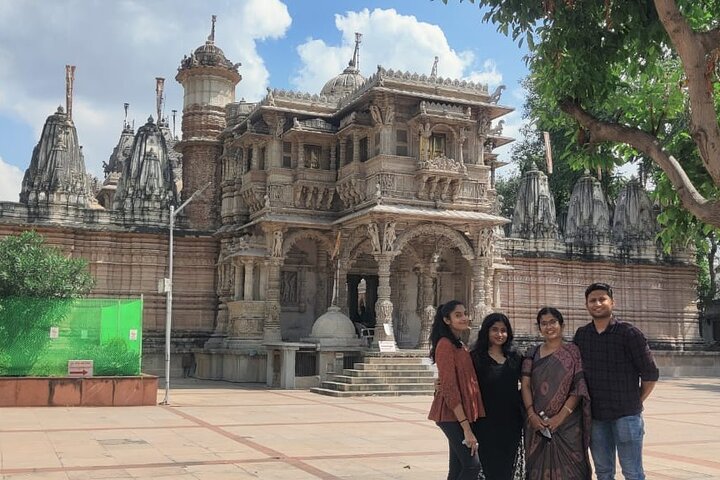
The tour focuses on the monuments and sites like tomb, mosque, fort & stepwell located at the center of the city.
Inkludert
Dette er inkludert
- Air-conditioned vehicle
Rute
Rani no Hajiro also known as Mughalai Bibi's Tomb or Tombs of Ahmed Shah's Queens was built-in 1445. The walls have beautifully carved stone screens and the courtyard has 8 carved marble tombs of queens of Ahmed Shah I and other Gujarat Sultanate rulers. The main tomb belongs to Mughalai Bibi, mother of Mahmud Begada and the wife of Muhammad Shah II carved in white marble. The tombs are covered with beautiful rich brocade works, the textile style that developed during rule of Ahmed Shah I. The intricate stonework and carving is a mixture of Hindu, Jain, and Islamic architectural styles.
Raja no Hajiro or Badshah no Hajiro is a kings mausoleum and has a group of tombs. The famous Ahmed shah’s tomb is situated in Manek Chowk area close to Jumma Masjid and opposite to Rani no Hajiro. The mosque consists of tomb of Ahmed Shah I, the founder of Ahmedabad city. The mosque was completed by his son Muhammad shah in 1414 and who is buried to his left. The grandson of Ahmed shah Qutud-Din Shah is buried to his right. Being a multi-culture space we can see the influence of Hindu culture in its practices like oil lamp practice. The mosque has a main square building with a central dome and four chambers at four corners with small domes. It has beautifully carved
The Jumma Masjid also known as Friday mosque was erected by Ahmed Shah 1 (A.D. 1411- 1441) in 1424. It has three side entrances portico on eastern, northern and southern side. The pillars of the prayer hall entrance have beautifully carved motifs influenced by different cultures of the city like lotus flowers. The prayer room is a rectangular space with four domes. It has 260 pillars and 15 domes. It has a wide-open courtyard, marble •ooring, walls painted with giant Arabic calligraphy and has a tank for ritual ablutions in the center. Visit Jumma Masjid will overwhelm you with its large complex within the narrow lanes of the city.
Fort constructed in the year 1411 A.D. during the rule of Marathas, was established by Sultan Ahmad Shah, the founder of the city. Fort was named after the presence of Bhadra goddess temple built during the reign of the Marathas. In addition, it is also said that Sultan Ahmad Shah built the Bhadra gate for entering the fort. The Bhadra Fort consists of the palace, the beautiful Nagina Baugh and the Ahmed Shah's Mosque on the west along with a wide-open area known as Maidan-Shah on the east side. It had a fortified wall with 8 gates, 14 towers and 2 openings covering an area of 43 acres.
Built-in 1485 using sand stone in Hindu-Islamic architectural style, the Dada Harir stepwell is •ve stories deep and octagonal in shape at the top. Built on intricately carved large pillars, entrance is from the East and two spiral staircases are in the West. On the walls, as you step down you can see carvings in Sanskrit as well as in Arabic script. Stepping down story by story will astonish you by its intricate carving and architecture that makes it worth experiencing.
Avbestilling
All sales are final. No refund is available for cancellations.
Greit å vite
- Møtested
- Opp. Sidi Saiyad Mosque
- Henting
- Alle møtes ved startstedet; det er ingen henting.
- Billettype
- Mobile or paper ticket accepted
- Arrangeres av
- The House of MG
- Public transportation options are available nearby
- Infants are required to sit on an adult’s lap
- Not recommended for pregnant travelers
- Not recommended for travelers with poor cardiovascular health
- Suitable for all physical fitness levels
How it compares in Ahmedabad
- Its from-price is 55% below the median of the 152 experiences we list in Ahmedabad.
- It is shorter than most of them.
About Ahmedabad
Ahmedabad, on the Sabarmati River in Gujarat, is a historic merchant and textile city of carved wooden houses, mosques and Gandhi's ashram.
Ahmedabad was founded in 1411 by Sultan Ahmad Shah on the banks of the Sabarmati, and its walled old city is listed by UNESCO. Its pols, tight clusters of homes around shared courtyards, have carved wooden fronts. The Jama Masjid, the Sidi Saiyyed Mosque with its lattice window carved as a tree, and the Teen Darwaza gateway show the Indo-Islamic style of the sultanate.
Top-ranked sights in Ahmedabad: Sabarmati Ashram, Adalaj Stepwell (Adalaj ni Vav), Sidi Saiyyed Mosque.
Lignende opplevelser
 Gratis avbestilling
![1-dagers tur til Taj Mahal og Agra med kommersielle flyreiser fra begge sider]() Gratis avbestilling