Travnik Jajce tour
설명은 영어로 표시됩니다.
- 7–10시간
- 영어 가이드
- 프라이빗 투어
- 모바일 티켓
하이라이트
All our tours are made for our guests, so they are the ones who create and customize the tours as they wish.
포함 사항
포함되는 것
- Private transportation
- Air-conditioned vehicle
- Fuel surcharge
- Parking Fees
포함되지 않는 것
- Lunch
- Dinner
일정
Travnik Castle, locally known as old town castle, is a medieval town-fortress complex in the city of Travnik, Central Bosnia. Dating back to pre-Ottoman Bosnia when the former Christian Kingdom ruled the region, there is no historical data as to the construction date of the Medieval fortress. However, the construction type and other characteristics indicate that it was built sometime in the second half of the 14th century or in the first half of the 15th century. As a result It was probably built during the time of the Bosnian Kings Tvrtko II or Ostoja, and then rebuilt and expanded during the time of Stephen Thomas. The Travnik fortress was erected before the arrival of the Ottoman Turks for the purpose of defense, as the Ottomans penetrated deeper into Bosnia. Travnik itself was one of a number of fortified towns in the region built for this purpose, but was built too late to stem the Ottoman advance.
The colorful mosque, or Suleimaniya, is a mosque located in Travnik, in a section called the Lower Čaršija, and is assumed to have been built in the second half of the 16th century. The mosque of the mosque's first renovator is said to have been built by Gazi-aga. In 1757, vizier Camil Ahmed-aga erected a mosque called by the inhabitants of Camili. It was burned in a fire in 1815, and in its place a new mosque was erected by Bosnian vizier Sulejman Pasha Skopljak. She was named Colorful because of her unusual interior and exterior wall decorations. The ground floor of the mosque is stateless. Suleimania is a unique example in Ottoman architecture where the same building is used for sacral and secular purposes.
Ivan Andrić; 9 October 1892 – 13 March 1975 was a Yugoslav novelist, poet and short story writer who won the Nobel Prize in Literature in 1961. His writings dealt mainly with life in his native Bosnia under Ottoman rule.
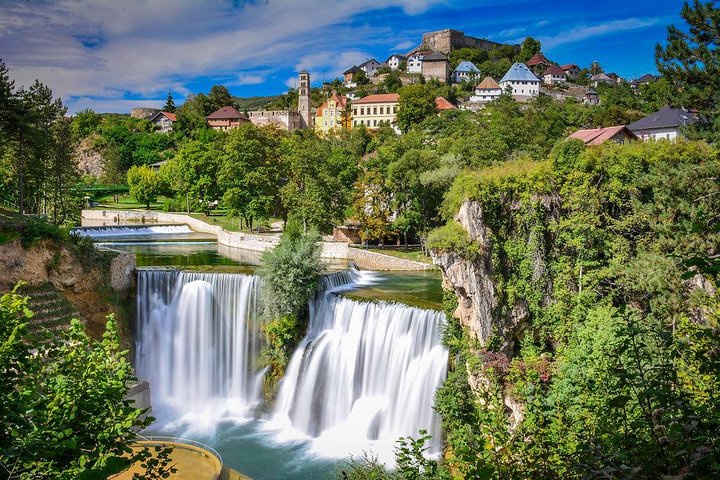
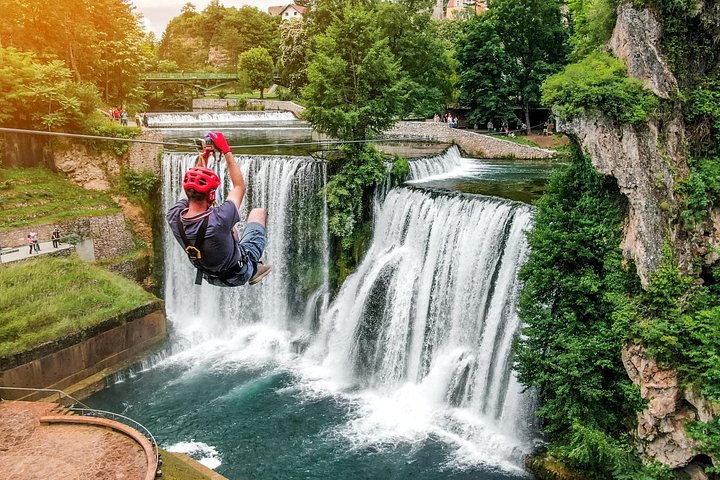
The Pliva Waterfall is located by the town of Jajce, in central Bosnia and Herzegovina, where the river Pliva meets the river Vrbas. It was 30 meters high, but after an earthquake during the Bosnian war and attacks on the power plant further up the river, the area was flooded and now the waterfall is 22 meters high.
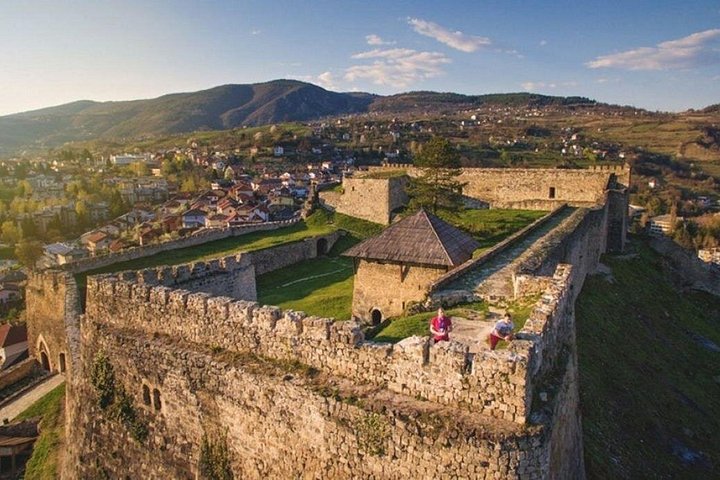
The Walled City of Jajce is a medieval fortified nucleus of Jajce in Bosnia and Herzegovina, with citadel high above town on top of pyramidal-shaped steep hill, enclosed with approximately 1,300 metres (4,300 ft) long defensive walls,. It is one of the best preserved fortified capitals of the Bosnian Kingdom, the last stronghold before to kingdom dissolved under the pressure of military advancement at the onset of Ottoman Empire takeover.
The Pliva lakes, which include the Great and the Small lakes, originated on the Pliva River, the left tributary of the Vrbas in Jajce. The lakes are located in the Pliva Valley, between Jajce and the settlement Jezero. The Great Lake lies at an altitude of 424 m. It is about 3.3 km long, with an average width of about 400 and a maximum of about 700 m. The maximum depth of the lake is about 36 m. It originated at the point where Pliva ends its course, downstream of the settlement Jezero, and ends at the settlement Zaskoplje.
취소 규정
All sales are final. No refund is available for cancellations.
출발 전 알아둘 점
- 픽업
- 모든 인원 픽업이 포함됩니다.
- 티켓 종류
- Mobile or paper ticket accepted
- 운영사
- Royal Bear Tour
- Infants and small children can ride in a pram or stroller
- Public transportation options are available nearby
- Infants are required to sit on an adult’s lap
- Specialized infant seats are available
- Suitable for all physical fitness levels
How it compares in Sarajevo
- Its from-price is 12% above the median of the 114 당일치기 여행 we list in Sarajevo.
- Its length is typical for the group.
About Sarajevo
Sarajevo, capital of Bosnia and Herzegovina, lies in a mountain-ringed valley where Ottoman bazaars meet Austro-Hungarian boulevards.
Sarajevo follows the Miljacka River through a long valley with steep green hills on either side. Baščaršija, the old Ottoman bazaar, has copper workshops, tea houses and the Sebilj, a wooden fountain, and the Gazi Husrev-beg Mosque dates from the 1530s. West of it, the streets turn to Austro-Hungarian façades and cafés, so that a mosque, a Catholic cathedral, an Orthodox church and a synagogue all stand within a short walk.
Top-ranked sights in Sarajevo: Sarajevo Tunnel (Tunel Spasa), Sarajevo Olympic Bobsleigh and Luge Track, Latin Bridge (Latinska Ćuprija).
Sarajevo 특가
할인 전후 가격은 운영사가 정한 것이며, 저희가 붙인 것이 아닙니다.