Krakow Kazimierz Jewish District - PRIVATE (4h)
설명은 영어로 표시됩니다.
- 4시간
- 시작 24시간 전까지 무료 취소
- 8개 언어
- 즉시 확정
하이라이트
Our guide will greet you at the hotel and invite you for the fully private sightseeing. Get to know the sights in Poland's capital on a tour to explore the city of Warsaw. With the company of a private guide, you visit some of the most important sites from the city's long and remarkable past, all as you get to know the city's background and its role in the history of Poland. Start your route with a visit to the city's Old Town, a UNESCO World Heritage Site. Pass the former residence of Polish monarchs at the Royal Castle, the Baroque edifice of Krasinski Palace, the modern columns of the Supreme Court building, and the monument dedicated to the Warsaw Uprising of 1944. Next, visit the city's largest park, Lazienki Park, where you see the famous monument to Frederic Chopin. Take the chance to relax in the beautiful rose garden and among the amazing nature of this place before the tour comes to an end with a ride back to your hotel.
포함 사항
포함되는 것
- Professional local guide
포함되지 않는 것
- Gratuities
- Entries to Synagougues
일정
Another historical municipality in the outskirts of Krakow, Kazimierz, is now one of the city's most attractive districts. Dotted with old buildings which give a special ambience to the area, Kazimierz was home to the larger part of the Jewish population of Krakow tilll 1939. Here, we find the famous Remuh Synagogue and the Alte Schule,Poland's oldest synagogue, today an important museum of the district. Worth a visit is also the Temple founded by the local Association of Progressive Jews and the Wolf Popper synagogue.
The factory at Lipowa street was launched two years before the Second World War. In the autumn of 1939 it was confiscated from three Jewish owners and taken over by a Sudeten German, Oskar Schindler (1908–74), a member of the NDSAP and most probably a collaborator of the Abwehr. Thanks to his extensive network of connections, the businessman won plenty of commissions, both civilian (pots, spoons, et cetera) and military (including mess kits, and later also ammunition shells) for his Deutsche Emailwarenfabrik commonly known as Emalia, which earned him a fair revenue. Schindler employed Jews initially for economic reasons as they provided a cheap labour force. Most probably the establishment of the ghetto and the subsequent brutal deportations made the businessman aware that as a director of a prospering factory, he had an opportunity to help these people.
Rising up around it was a plethora of synagogues, Jewish schools, academies, and institutions. For centuries, it was one of the most important Jewish cultural and spiritual centres in Europe. This is where the famous scholar and rector of the Talmudic Academy, Moses Isserles known as Remuh, lived in the 16th century. Jews from all over the world come on pilgrimages to his grave, a site that abounds in legends. In the following century, the learned Rabbi Natan Spira studied the Kabbalah in the attic of the synagogue at 22 Szeroka Street by a small candle. The candle burnt out in 1633 and the famous Kabbalist died, of exhaustion as rumour had it.
On November 24th, 1993, under the auspices of the Judaica Foundation, the Jewish Cultural Centre was opened. The idea to create it was a public initiative of people concerned about protecting the Jewish cultural legacy in Poland, promoting this legacy among young generations, and preserving the memory of Jewish participation in and contribution to the Polish history. All these goals are pursued in hope that they will foster a harmonious development of Polish-Jewish relations and support the efforts to build an open democratic society. As laid down in the Statute of the Judaica Foundation, the Jewish Cultural Centre is open to all: its programmes are addressed to Jewish and non-Jewish populace, both Polish and foreign.
Tempel synagogue was erected in the years 1860-1862 in the round-arch style based on Ignacy Hercok' design. During several decades it was repeatedly expanded. The specificity of the progressive scheme of the Tempel Synagogue was the fact that the sermons were delivered once a week in Polish and German interchangeably. During World War II, the synagogue was turned into a warehouse, but the interior did not sustain as severe damage as other temples. The set of 36 stained-glass windows on the ground floor and the first floor, mainly with floral and geometric patterns, is both beautiful and unique. Many of the windows have retained signatures of their founders. The interior of the synagogue decorated in the Moorish style was thoroughly renovated in the years 1987-2000. Between 2006 and 2008, the Jewish Community Centre of Krakow was added to the back of the synagogue on the initiative of HRH the Prince of Wales.
The synagogue was built in the 1640s from the monies of the Kahal, which is why it is called Kupa, as the word means “fund”. In the 19th century it was repeatedly extended: first in the wake of the construction of Miodowa street. At that time a garden was designed between the street and the synagogue wall, and a storeyed wing and a balcony were built leading to the women’s area. Conservation and renewal works were also carried out between the two world wars. The interior was decorated with new paintings, and the entire building was surrounded with decorative fencing. During the German occupation the synagogue was devastated. The bimah (the raised roofed podium in the centre of the synagogue) was entirely destroyed, and so was the platform with stairs and kantor’s pulpit in front of the Aron Kodesh; the movable furnishing was also lost.
The Synagogue of Isaac son of Jacob was founded by Izaak Jakubowicz (Ajzyk Jekeles), an elder of the Kazimierz Kahal, in the 1530s. The construction was completed in the 1540s to produce not only the largest of the Kazimierz synagogues but also the most lavishly furnished. The spacious interior is decorated with stucco and polychrome decorations under a vaulted ceiling. It incorporates a high hall for men and a women’s section connected to the main hall through semi-circular arcades. The external staircase leading to the women’s section received its contemporary guise in 1924. The large square fronting the synagogue used to be a fish market until the Second World War: a frequently photographed, characteristic element in the townscape of the Jewish district. After the war, the building long remained derelict, and only after a thorough renovation early in the 1990s was the synagogue made available to visitors.
The High Synagogue was built as the third synagogue in the Jewish town of Kazimierz, after the Old Synagogue and the Remuh Synagogue. It was erected after 1556, but no later than 1563. The name of the synagogue comes from the fact that its prayer hall was located on the first floor of the building. This atypical placement of the prayer house was a result of security concerns: the synagogue stood next to a gate to the Jewish town, which was a particularly crowded place, full of street noise and in very close proximity to Christian buildings at the time. The eastern section of the building probably contained shops from the very beginning of the synagogue's existence. At the end of the 1880s, men's and women's prayer sections were created on the first floor of a building adjoining the synagogue from the west, and added to the temple. The fate of the synagogue during World War II and in its aftermath was not documented.
The Old Synagogue is the oldest monument of Jewish sacral architecture preserved in Poland. Built in the the 15th century as a two-aisle hall with a cross-ribbed vault supported by two pillars and covered by a gable roof, in terms of architectural style it draws upon the Gothic synagogues in Worms, Regensburg and Prague. In 1570, it was converted by a builder from Florence, Matteo Gucci. Its walls were crowned with an attic, used for the first time in the architecture of synagogues in Poland. Between 1550 and 1650, it was extended, one by one, with a porch, two prayer rooms for women and a house for the community council, known as kahal. Together with the kahal house, the synagogue formed a religious and administrative centre of the Jewish community in Kazimierz. In late 1944, its vault collapsed, maybe destroyed deliberately. In 1956-59, it was restored, and at the same time adapted to function as a museum.
The Remuh Synagogue and its adjoining cemetery is enclosed with five streets: Szeroka, Miodowa, Jakuba, Ciemna and Lewkowa. It is a unique complex of Jewish architecture and religious art dating back to the mid-16th century, functioning as a centre of the religious life of Jews in today's Kraków. The synagogue holds services on Saturdays and holidays and the cemetery is visited by religious Jews from all over the world who wish to pray by the graves of well-known Kraków rabbis, scholars and outstanding community seniors. The old cemetery was mostly visited by pilgrims on the anniversary of the death of the most famous Polish rabbi, Moses Isserles (1525-1572), also known as "The Rema", falling on the 18th Ijar (April/May) of the Jewish calendar. This second oldest synagogue in the Jewish Kazimierz district, initially called the "New Synagogue", was erected in 1553 by Israel ben Josef, grandchild of Moses Auerbach of Regensburg and father of Moses Isserles.
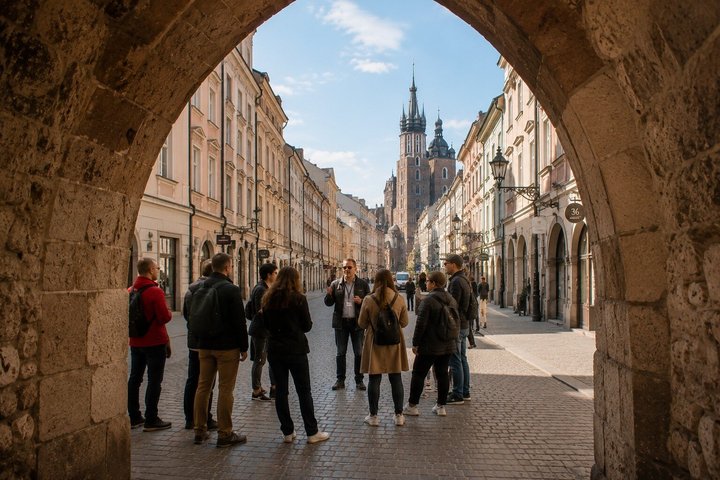
From the budget milk bars, slow food restaurants, food trucks, and high end dining Kraków is the place to be. Named the European Capital of Gastronomic Culture 2019, Kraków promises to satisfy any tastes, especially those seeking traditional and regional flavors. As far as the entertainment goes, Kraków is home to countless venues and establishments offering a wide range of experiences from refined to casual.
where you see the famous monument to Frederic Chopin
취소 규정
체험 시작 24시간 전까지 무료로 취소하고 전액 환불받을 수 있습니다.
후기
5.0
- 51
- 40
- 30
- 20
- 10
평점은 저희 예약 파트너가 모은 후기 1개를 바탕으로 합니다. 여행자가 직접 쓴 글을 쓰인 순서 그대로 보여주며, 체험을 좋아 보이게 하려고 순서를 바꾸지 않습니다.
출발 전 알아둘 점
- 미팅 장소
- Nearby Synagogue Bne Emuna
- 픽업
- 모두 출발 장소에서 모이며, 픽업은 없습니다.
- 티켓 종류
- Mobile or paper ticket accepted
- 운영사
- PT Team
- Public transportation options are available nearby
- Infants and small children can ride in a pram or stroller
- Suitable for all physical fitness levels
How it compares in Krakow
- Its from-price is close to the median of the 98 시티 투어 we list in Krakow.
- It is longer than most of them.
- By number of reviews it ranks 56 of 98.
- The operator lists free cancellation on it.
About Krakow
Kraków, Poland's royal former capital, has a beautifully preserved medieval old town, crowned by Wawel Castle above the Vistula River.
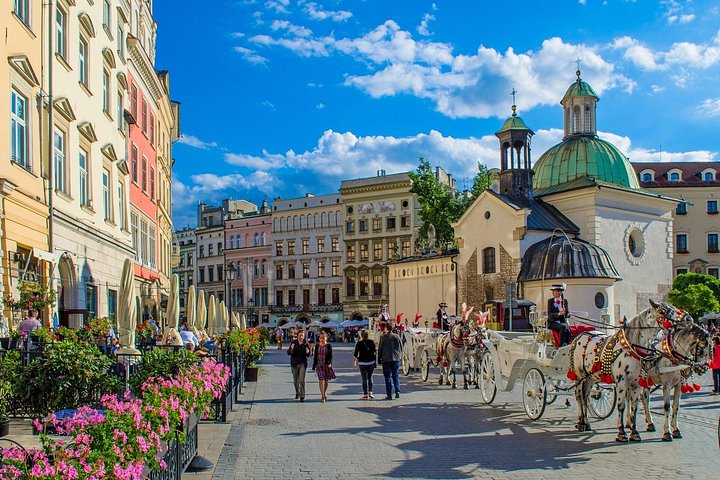
The Main Market Square, one of the largest medieval squares in Europe, is lined with burghers' houses and centred on the arcaded Cloth Hall. St Mary's Basilica rises at one corner, its carved wooden altarpiece a Gothic masterpiece, and a trumpet call sounds from its tower through the day and night.
Top-ranked sights in Krakow: Auschwitz-Birkenau Memorial and Museum, Rynek Glowny (Main Market Square), Wieliczka Salt Mine (Kopalnia Soli).
Krakow 특가
할인 전후 가격은 운영사가 정한 것이며, 저희가 붙인 것이 아닙니다.