Tour Amalfi & Paestum
説明は英語で表示されます。
説明文は主催者によるもので、自動的に翻訳されています。
- 8時間
- 24時間前まで無料キャンセル
- 5言語
- 即時確定
見どころ
"It is as if a god here had built his house with enormous blocks of stone." Friedrich Nietzsche described the magnificence of Paestum during his visit. Recognized by UNESCO as a World Heritage Site since 1988, visiting it is like doing a plunge into history and an unforgettable journey to different eras.The site, in addition to comprising the National Museum and the remains of the ancient Greek agora, contains 3 temples dedicated to Hera, Athena and Neptune, built around 500 BC. city is contained by monumental stone walls with a pentagonal perimeter interspersed with 24 watch towers.
含まれるもの
料金に含まれるもの
- Bottled water
- Air-conditioned vehicle
- parking - fuel - tolls
含まれないもの
- tips and anything that is considered extra are excluded
行程
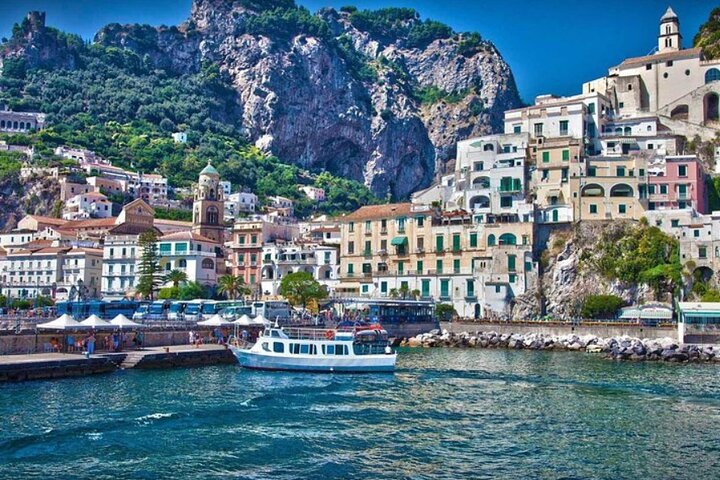
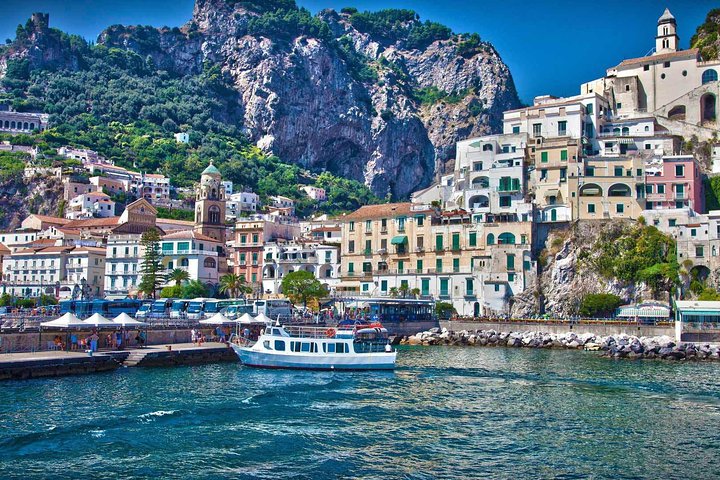
The itinerary proposed cannot but start from Piazza Flavio Gioia. the name of this square is not causal. According to tradition, Flavio Gioia was an Italian inventor and navigator who was born in Amalfi between the 13th and 14th centuries, to whom the invention or improvement of the magnetic compass owes. The statue is the work of Alfonso Balzico and is dated 1892. Piazza Flavio Gioia is considered the gateway to Amalfi, as it is the first that tourists encounter arriving in the city. A short distance away is the heart of the historic center in Piazza Duomo.
Continuing on foot from Via Duca Mansone I strolling through souvenir shops and ceramics in a few seconds you arrive in Piazza Duomo, the heart of Amalfi. The undisputed protagonist of the square is the Cathedral of Sant'Andrea which houses the remains of the saint, patron saint and protector of the city. The cathedral of Sant'Andrea is the main place of Catholic worship in Amalfi, the bishop's seat of the Archdiocese of Amalfi-Cava de 'Tirreni. According to a legend, St. Francis of Assisi went to this building in 1218 to worship. the relics of the apostle kept there and remained in the city for two years. On that occasion he founded the convent of Santa Maria degli Angeli, later dedicated to Sant'Antonio.
Paestum is an extremely important archaeological site, recognized in 1998 by UNESCO as a World Heritage Site, together with the Cilento and Vallo di Diano National Park. The site is located in the Municipality of Capaccio in the Province of Salerno. The "Piana di Paestum", as our ancestors called the flat extension from the foot of the hills to the sea, was already inhabited in prehistoric times. Strabo - the most famous Roman geographer - tells that Jason (the hero of the golden fleece, the skin of the golden ram who had the power to heal by magic), driving the Argonauts, stopped at the mouth of the Sele river, where he dedicated a shrine to Hera (protector of the Argonauts). It was the fertility of the plain and the abundance of the waters of the Sele that would have made the plain, later called pestana, one of the main stages between the East and the West already in the second millennium BC The Greeks, appreciating the geographical position, founded there around 600 BC a city they will call Poseidonia, in honor of the god of the sea. The significant building development took shape around the middle of the 6th century BC, in fact the construction of the temples began a few decades after the founding of the city. The three Greek temples of Paestum, built between the VI and V centuries a.C., together with those of Athens and Agrigento are the best preserved templar buildings from the classical age. The temples rise in the central part of the city, which extends for over 120 hectares and is surrounded by a wall, which even if it is not preserved for all its height, is one of the best preserved defensive circuits in Magna Grecia. The perimeter, of trapezoidal shape, is 4750 meters long, with twenty-eight towers placed to defend the four access gates to the city: Porta Giustizia, Porta Marina, Porta Sirena and Porta Aurea (destroyed with the construction of the Calabrie road). Among the temples was the "market", that is the central square where the assemblies of the citizens were held and the tomb (empty, in reality) of the mythical founder of Paestum was venerated. The residential quarters extended around the temples and the market. The remains of houses, spas and shops that can be seen today on the site date back largely to the imperial age (I-V century AD), while we still ignore many aspects of the Greek town. The magnificence of this colony, founded by the Achaean colonists fleeing from Sybaris, soon aroused the desire to conquer the Lucanians, an inland Italic population, who occupied it around 400 BC. changing its name to Paistom. The Lucanians, while not reaching the cultural level of the Greek period, continued their civil and military activities. They changed both the language (from the Greek to the c.osco) and the material culture and the funeral rites. However, elements of continuity are not lacking, such as, for example, the continuing function of the temples. Meanwhile, another power was expanding along the Peninsula: Rome. In 273 BC Rome founded a Latin colony there and gave the city the name of Paestum. It was a time of great transformation of the town. After the abandonment, Paestum was no longer spoken of for centuries, even though its temples stood solemnly among the thick vegetation. A bit of merit for the rediscovery must be ascribed to writers and poets of the ‘500 and‘ 600 who, with their quotations aroused their interest and curiosity. But the real rediscovery began in the first half of the '700. This is the moment in which Paestum becomes a destination for cultured and refined tourism, which will see European intellectuals and aristocrats staying in its ruins as a mandatory stop on the Grand Tour. The site has attracted travelers and artists such as Piranesi and Goethe. The excavations of the city that began in the spring of 1907 brought to light most of the monuments visible today. With the arrival at the direction of the excavations of Mario Napoli, the area is experiencing a moment of great attention. These are the years of the discovery of the tomb of the diver and the rich Lucanian tombs. On 27 November 1952 the National Museum was inaugurated, which introduces with linearity the four crucial seasons of the life of Paestum and its territory, from prehistory to Greek, Lucan and Roman civilization.
キャンセル
開始24時間前まで無料でキャンセルでき、全額返金されます。
参加前に知っておくこと
- 送迎
- 送迎は全員に含まれます。
- チケットの種類
- Mobile or paper ticket accepted
- 催行会社
- Shore Excursion in Naples
- Infants and small children can ride in a pram or stroller
- Service animals allowed
- Public transportation options are available nearby
- Infants are required to sit on an adult’s lap
- Specialized infant seats are available
- Suitable for all physical fitness levels
How it compares in ナポリ
- Its from-price is 133% above the median of the 1168 日帰りツアー we list in ナポリ.
- Its length is typical for the group.
- The operator lists free cancellation on it.
About ナポリ
ヴェスヴィオ山の麓で情熱的かつ混沌としたナポリは、ピッツァ発祥の地であり、ポンペイ、カプリ、アマルフィ海岸への玄関口です。
古代ギリシャ人が整えた碁盤目状の通りが密集する歴史地区は、教会、路傍の祠、バルコニーの間に渡した洗濯物の世界です。スパッカナポリが一直線に貫き、サン・グレゴリオ・アルメーノ通りには降誕場面の人形工房が並び、サンセヴェーロ礼拝堂には驚くべき「ヴェールをかぶったキリスト」があります。地下には、トンネルと貯水槽が、足元に眠るギリシャ・ローマ時代の街を見せてくれます。
Top-ranked sights in ナポリ: Mt. Vesuvius (Monte Vesuvio), Via dei Tribunali, Naples Historic Center (Napoli Centro Storico).
ナポリの特別価格
割引前と割引後の価格は事業者が示すもので、当サイトが付けたものではありません。