Private Tour of Communist Era Budapest
説明は英語で表示されます。
- 7〜10時間
- 24時間前まで無料キャンセル
- 英語のガイド付き
- 即時確定
見どころ
Take an all-encompassing and unique roundtrip of communist Budapest and get to know Hungary's capital city from a completely different angle! This one-day private tour for 1 to 7 people — perfect for solo travelers, couples, families, or small groups — features numerous interesting stops, uncovering hidden gems from Hungary’s communist past and key sites of the 1956 revolution against communist rule, where no other tour operator is likely to take you. Beyond the regular communist round of the inner city, you'll explore lesser-known yet fascinating architectural gems of the era and then venture to the suburbs where communism truly thrived. Tour the communist housing estates, and explore the Csepel Iron and Metal Works, a crucial communist industrial stronghold. And have a drink in a communist era coffee house (presszó)! The tour culminates at Memento Park, an open-air museum preserving Budapest's iconic communist statues, offering a powerful reflection on Hungary's turbulent past.
含まれるもの
料金に含まれるもの
- Travel in a certified passenger transport vehicle with a licensed professional driver/guide
- Soda/Pop
- Bottled water
- A drink in a communist era coffee house
- Snacks
含まれないもの
- Memento Park
- Lunch
行程
We will start our journey on beautiful Szabadság Square in downtown Budapest. At the Memorial for Victims of the German Occupation, I will give you a short overview of the history of Hungary and the events that led to the Communists assuming power here. At the memorial of the Soviet liberation of Hungary in World War II from Nazi German occupation, I will briefly tell you about the beginning of the communist era in Hungary and the Stalinist dictatorship of the late '40s and early '50s that marked one of the darkest eras of Hungarian history. From here, we will go to a nearby square which has some of the few remaining examples of Socialist Realism, also called Stalin Baroque - a huge residential complex which has some interesting reliefs in its inner courtyard - and even a statue of a bear riding a scooter (!)
We'll pause at the House of Terror Museum, located at 60 Andrássy Avenue. This iconic building was once the headquarters of the fascist Arrow Cross Party during World War II and later the central office of the communist secret police (ÁVH). While we won't enter this time, the building itself symbolizes the dark periods of 20th-century Hungarian history under totalitarian regimes. Travelers interested in a deeper exploration can visit the museum independently later.
Our next stop will be Bem Square on the Buda side, where the Hungarian revolution of 1956 started. Here, I will tell you about the history of the revolution and the significance of this square in the protests, which then spread out from here all across the city.
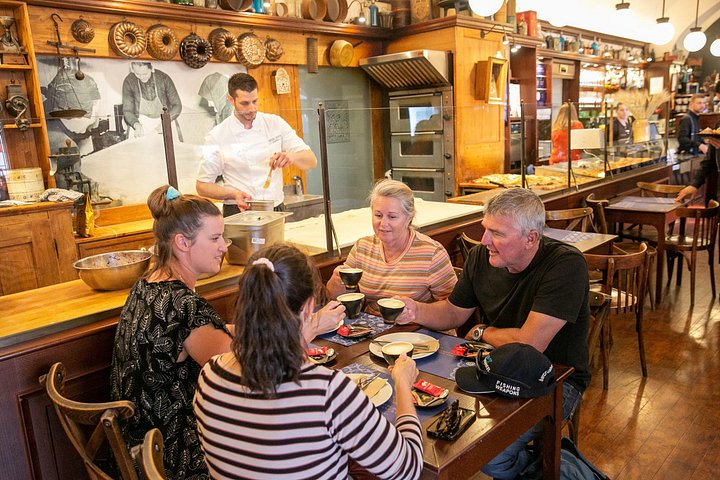
Let me invite you for a drink at a real time capsule from the communist era! This coffee house/bar (presszó in Hungarian) from communist times has been preserved in its original form.
The Liberty Statue atop Gellért Hill—one of Budapest’s iconic landmarks—has stood proudly for 78 years. Unveiled on April 5, 1947, it was meant to symbolize victory and peace, though many came to associate it with the Soviet occupation. Originally named the Liberation Monument, its inscription once read: “In memory of the liberating Soviet heroes.” The statue, holding a palm branch, was modeled after a young nurse, Erzsébet Gaál—whose unexpected role as the “living Liberty Statue” became both a blessing and a curse. I’ll share more about the monument and her fascinating story during our tour. Although the statue and the Citadel are currently under renovation (expected to reopen in December 2025), we can still walk around the site and climb the steps up to the monument. The surrounding area offers several scenic lookout points with breathtaking views of the city—perfect for photos!
The Technical University's H, T and R buildings are probably the largest examples of the few remaining Socialist Realist buildings in Hungary - and are actually quite well-designed, especially the facade of the R building, our next stop. During weekdays, we can also enter the building, and inside, as somebody put it, Moscow awaits...
The market hall on Fehérvári Street is quite a special one - and not only because my father often took me on shopping trips here when I was a kid (I will also share a few personal stories from communist times during the tour). Originally a distinctive 1977 brutalist building, it was later covered with a bland white box-like exterior—a transformation that symbolizes Hungarian architecture's misunderstanding and rejecting the design principles of brutalism, an architectural style that the Soviet Union was especially fond of. While having a look at the characteristic concrete surfaces and innovative ramps inside the market hall, you will also have a chance to browse and shop some original Hungarian goods, should you wish. Opening hours: Nyitvatartás Mon: 06.30 – 17.00 Tue – Fri: 06.30 – 18.00 Wed: 06.30 – 15.00 Sun: 7.00 – 14.00
Enjoy lunch at a hidden gem, a local favorite far from the tourist crowds. The menu is only in Hungarian, but I'll help you choose something you'll love.
Stepping into Memento Park is like stepping back in time to the final moments of Hungary's communist dictatorship. This open-air museum serves as a powerful historical archive, preserving the imposing statues and monuments that once stood as symbols of the regime around Budapest. Here, you can get immersed in a thought-provoking, emotional journey - from the striking symbolism encoded within the artworks to the visceral sensation of seeing these colossal relics of a bygone era decaying under the elements. The park offers a unique opportunity to reflect on Hungary's turbulent past and the complex, bittersweet process of transition to democracy. Oh, and you can sit into a real East-German Trabant - probably the worst communist car ever made!
Our next stop is the Csepel Island in the Danube, which earned the nickname "Red Csepel" during the communist era due to its significant role as an industrial hub and a stronghold of the working class in Hungary. Here, we will visit the Csepel Iron Works, a massive industrial complex that was a symbol of Soviet-style industrialization in Hungary. The factory employed tens of thousands of workers and produced a wide range of products, including steel, machinery, and vehicles. Interestingly, the workers of Csepel played a crucial role in the 1956 Hungarian Revolution, and held out even when everything else had fallen. The factory is surrounded by one of Budapest's largest communist style tower block housing estates, where we will pass while looking at some other surviving examples of socialist realist art and architecture.
キャンセル
開始24時間前まで無料でキャンセルでき、全額返金されます。
口コミ
5.0
- 57
- 40
- 30
- 20
- 10
評価は予約パートナーが集めた7件の口コミによるものです。旅行者自身の言葉を書かれた順に掲載しており、体験をよく見せるために並べ替えることはありません。
参加前に知っておくこと
- 送迎
- 送迎は全員に含まれます。
- チケットの種類
- Mobile or paper ticket accepted
- 催行会社
- Tamas Varga
- Wheelchair accessible
- Infants and small children can ride in a pram or stroller
- Service animals allowed
- Public transportation options are available nearby
- Specialized infant seats are available
- Transportation options are wheelchair accessible
- All areas and surfaces are wheelchair accessible
- Suitable for all physical fitness levels
How it compares in ブダペスト
- Its from-price is 90% above the median of the 1255 experiences we list in ブダペスト.
- It is longer than most of them.
- By number of reviews it ranks 448 of 1255.
- The operator lists free cancellation on it.
About ブダペスト
ブダペストはドナウ川を挟んで丘陵のブダと平坦なペストが向かい合い、温泉、川沿いの宮殿、にぎやかなルインバーが魅力の壮麗な首都です。
ブダ側の王宮の丘には、ブダ城、マーチャーシュ教会、白い尖塔の漁夫の砦が並び、いずれも川を見下ろしています。くさり橋でペスト側に渡ると、川岸にハンガリー国会議事堂が長く延び、数ブロック内陸には聖イシュトヴァーン大聖堂がそびえます。ゲッレールトの丘とツィタデッラからは、街で最も広い眺めが得られます。
Top-ranked sights in ブダペスト: House of Parliament (Országház), Buda Castle (Budai Vár), Chain Bridge (Széchenyi Lanchid) .
ブダペストの特別価格
割引前と割引後の価格は事業者が示すもので、当サイトが付けたものではありません。