Experience Seoul Like Locals in Small Group
説明は英語で表示されます。
- 7〜8時間
- 24時間前まで無料キャンセル
- 英語のガイド付き
- 即時確定
見どころ
Discover the best of Seoul in just one day with this small-group tour, designed for travelers who want to visit the city's most iconic landmarks efficiently and affordably. Start your journey at Jogyesa Temple, a serene Buddhist site, before stepping into history at Gyeongbokgung Palace and learning about Korean heritage at the National Folk Museum. Pass by the Blue House, explore the charming streets of Insadong, and admire the beauty of Changdeokgung Palace, a UNESCO-listed gem. End your adventure at the lively Namdaemun Market, where you can shop and sample delicious street food. Enjoy the benefits of a small-group experience—more interaction with your guide, faster access to sites, and a relaxed, friendly atmosphere. Unlike large bus tours, this intimate setting ensures less waiting, more exploring, and a great value for your money. If you want to experience Seoul’s highlights without the hassle, this tour is the perfect choice. Book now and make the most of your time in the city!
含まれるもの
料金に含まれるもの
- All Fees and Taxes
- Air-conditioned vehicle
含まれないもの
- Lunch
- Snacks
- Personal Expense
行程
Pass by the famous Landmarks (City hall, Cheonggyecheon Stream and Gwanghwamun Square)
As the main temple as well as the district head temple of the Jogye order in Seoul, Jogyesa Temple is the center of Korean Buddhism. The temple was built in the late 14th century during the Goryeo period but was completely destroyed in a fire. It was rebuilt under the name of Gakwangsa Temple in 1910 with the effort of many respectful monks, namely Han Yong-un and Lee Hee-gwang. The temple was given a role as the head temple of Korea’s Buddhism and renamed to Tegosa Temple in 1936. In 1954, a purification drive took place to eliminate Japanese influence and revive traditional Buddhism, which established the present day Jogyesa Temple as a result.
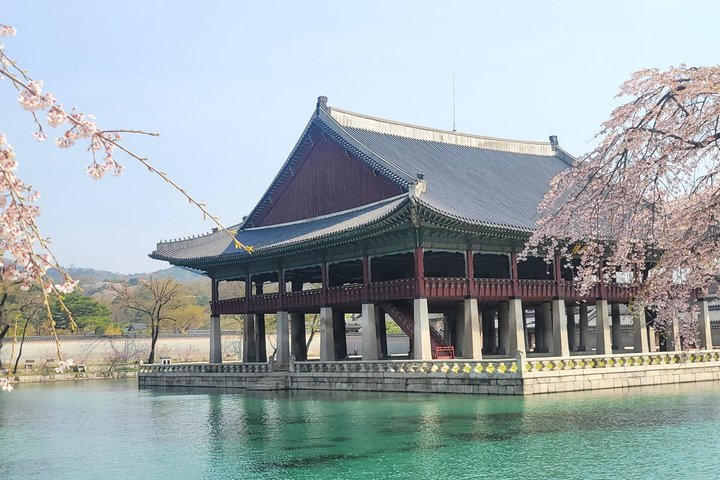
Gyeongbokgung Palace was built in 1395 as the official palace of the Joseon dynasty by Yi Seong-gye, the future King Taejo and founder of the new regime. Gyeongbokgung Palace is commonly referred to as the Northern Palace because of its location to the north, comparied to Changdeokgung Palace in the east and Gyeonghuigung Palace in the west. Gyeongbokgung Palace is arguably the most beautiful and is the largest of all five palaces. Many Joseon kings were crowned here. The premises were once destroyed by fire during the Imjin War (1592-1598). However, all of the palace buildings were later restored under the leadership of Heungseondaewongun during the reign of King Gojong. On Tuesdays, the Gyeongbokgung Palace is closed, so you will go to Changdeokgung(including secret garden) instead.
Located inside Gyeongbokgung Palace, the National Folk Museum of Korea presents historical artifacts that were used in the daily lives of Korean people in the past. Through the displays, visitors can learn about the domestic and agricultural lifestyles, as well as Korea’s cultural beliefs. The National Folk Museum of Korea has three permanent exhibitions and two special exhibitions as well as a library, souvenir shop, and other subsidiary facilities.
The signature markings of the Presidential Residence of Cheong Wa Dae are its blue tiles on the Main Office; it is the first thing to catch one's attention upon viewing the premises. Approximately 150 thousand tiles compose the roof of the Main Office. Each tile was baked individually to make them strong enough to last for hundreds of years. The blue tiles and the smoothly curving roofline blend beautifully with Bugaksan Mountain in the backdrop.
Korean Special Products Shopping (Amethyst or Redpine or Ginseng Center)
Insadong is a popular tourist destination for visitors from all around the world, thanks to its numerous art galleries, restaurants serving Korean table d’hote, traditional teahouses, and street vendors lining the streets. Its most recognizable feature is the use of Hangeul (Korean script) in storefronts, which allows the visitors to really see just what makes this place so special. Unlike the nearby Ikseon-dong Hanok Street, Insadong Cultural Street has larger streets with wider stores, so it is much easier to traverse. On evenings and weekends, one can find buskers performing on the side of the road.
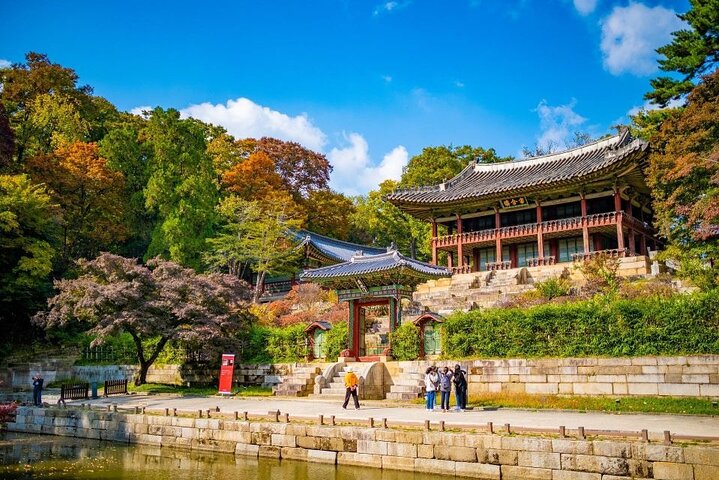
This walking tour takes visitors around Changdeokgung (Changdeok Palace), the second grand palace of the Joseon Dynasty, built in 1405 by King Taejong (the 3rd king of the Joseon Dynasty). In 1592, the main palace, Gyeongbokgung, was completely destroyed by fire during the Japanese Invasion of Korea and Changdeokgung became the home of the Joseon court for 270 years. Changdeokgung was added to the UNESCO World Heritage List as being an outstanding example of Far Eastern palace architecture and garden design, exceptional for the way in which the buildings are integrated into and harmonized with the landscape. On Mondays, Changdeokgung Palace is closed, so we will visit Bukchon Hanok Village instead.
Opened in 1964, Namdaemun Market is the largest traditional market in Korea with shops selling various goods. All products are sold at affordable prices and the stores in this area also function as wholesale markets. Most of the goods are made directly by the storeowners. Namdaemun Market is even open overnight, from 23:00 to 04:00, and is crowded with retailers from all over the country. When day breaks, the site of busy shoppers bustling around the market creates a unique scene that attracts tourists worldwide. Namdaemun Market sells a variety of clothes, glasses, kitchenware, toys, mountain gear, fishing equipment, stationery, fine arts, accessories, hats, carpets, flowers, ginseng, and imported goods.
キャンセル
開始24時間前まで無料でキャンセルでき、全額返金されます。
口コミ
5.0
- 52
- 40
- 30
- 20
- 10
評価は予約パートナーが集めた2件の口コミによるものです。旅行者自身の言葉を書かれた順に掲載しており、体験をよく見せるために並べ替えることはありません。
参加前に知っておくこと
- 集合場所
- Hongik University Station Exit 3 by 08:30
- 送迎
- 全員が出発場所で合流します。送迎はありません。
- チケットの種類
- Mobile or paper ticket accepted
- グループの人数
- 最大15名
- 催行会社
- Sunny Seoul Korea Tour
- Wheelchair accessible
- Infants and small children can ride in a pram or stroller
- Public transportation options are available nearby
- Infants are required to sit on an adult’s lap
- Transportation options are wheelchair accessible
- All areas and surfaces are wheelchair accessible
- Suitable for all physical fitness levels
How it compares in ソウル
- Its from-price is 26% below the median of the 1500 experiences we list in ソウル.
- Its length is typical for the group.
- By number of reviews it ranks 674 of 1500.
- The operator lists free cancellation on it.
About ソウル
王宮と韓屋の村が、ガラスの高層ビル、にぎやかな市場、深夜の屋台街に混ざり合うソウルは、韓国の首都です。
朝鮮王朝の5つの壮大な宮殿が街を飾り、カラフルな衛兵交代式のある景福宮と、秘苑が静かな隠れ家となっている昌徳宮が代表です。その間にある北村韓屋村は、坂道に伝統的な瓦屋根の家々を残し、仁寺洞は茶屋、ギャラリー、工芸品で知られています。
Top-ranked sights in ソウル: Third Tunnel of Aggression, DMZ, Gyeongbokgung Palace.
ソウルの特別価格
割引前と割引後の価格は事業者が示すもので、当サイトが付けたものではありません。