Discover Ferrara city centre
説明は英語で表示されます。
- 2時間
- 24時間前まで無料キャンセル
- 4言語
- 即時確定
見どころ
Explore Ferrara on this private walking tour and discover its must-see attractions Guided walking tour led by a licensed private tour guide Discover this hidden Italian gem and the reason why Ferrara is called the first modern city in Europe Ferrara has retained its urban fabric virtually intact, discover how houses and town plannings were built and planned in rennaisance and medieval time. Customize your tour to suit your own interests
含まれるもの
料金に含まれるもの
- Private tour
- Professional guide
含まれないもの
- Transportation to/from attractions
行程
Complete with moat Ferrara's towering castle was commissioned by the Este family in 1385. Initially it was intended to protect the Este family from the town's irate citizenry, who were up in arms over tax increases, but in the late 15th century it became the family's permanent residence. Linked to the castle by an elevated passageway, the 13th-century Palazzo Municipale was the Este family home until they moved next door to the castle.The visit of the castle interior is not included in this tour
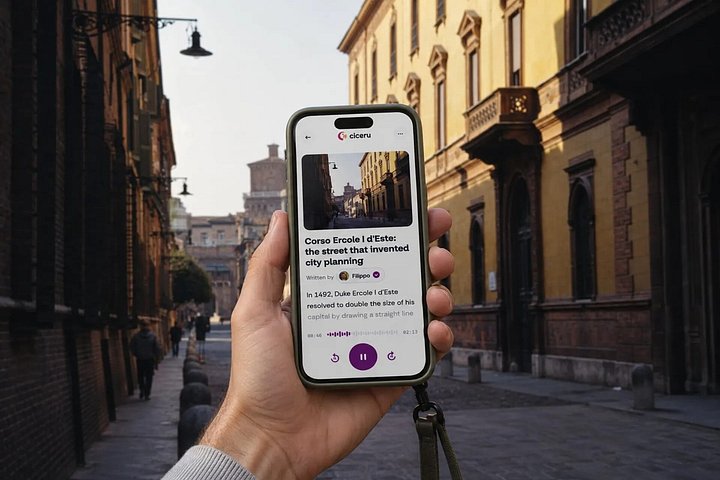
Throughout the Middle Ages and almost to the end of the 15th Century, the northern boundary of the city ran along the current road System of Viale Cavour-Corso Giovecca. In 1492 Ercole I commissioned to include this vast area in the centre (thus doubling the surface area of the city) and the great architect and town-planner, Biagio Rossetti, designed a plan which, due to its original and rational nature, made Ferrara the first modern city in Europe. In honour of the Duke who ordered the new town planning this great district is known as Addizione Erculea.
Between the castle and the town hall is Piazza Savonarola, dominated by the monument to Girolamo Savonarola, the famous reformer born in Ferrara in 1452 at the origin of the theocratic dictatorship of Florence (1494-1498). It was also he who had the idea of the pyre of vanities in which books and important works of art disappeared. He is represented here with his arms raised in the midst of preaching. The square is bordered to the west by Via Coperta, a five-arch building that connected the two Este family residences (the castle and the town hall)
The Piazza Cattedrale lies between today's town hall, former Este's residence, and the St. George cathedral. From the square you can have a beautiful view of the cathedral facade and its reliefs, a sort of poor man's bible
This Cathedral in the Romanesque-Gothic Lombard style has a beautiful tripartite façade endowed with a magnificent canopy (over the door), decorated with a depiction of the Last judgement.
Piazza del Municipio can be accessed directly from the cathedral square, passing through an imposing arch. The wide square, one of the former inner courtyards of the Este's ducal palace, is characterized by a staircase completely covered with white marble, finished in 1481.
The piazza Trento Trieste is the beating heart of the city. It dates back to the Middle Ages and the building of the new cathedral around which the seats of religious, civil and lordly power, in the shape of the family who in fact ruled Ferrara, were concentrated. Indeed, all the city's seats of power were sited in the piazza: as well as the cathedral, there was the bishops' house where the present Bishops Palace stands; the Palazzo della Ragione, the Notary's Lodge, the first nucleus of the Palazzo Ducale, today's Palazzo Municipale. Along the south side of the Cathedral runs the loggia dei Merciai. Also looking on to the piazza is the ex-church of San Romano, now home to a museum.
This commercial thoroughfare, the medieval town's main street, which once connected the market square (piazza Trento e Trieste) with the port of Ferrara (now replaced by the Via Ripagrande) is bordered by porched medieval houses.
This charming medieval street marks the axis along which the so-called linear Ferrara developed between the 7th and 9th centuries A.D. and which greatly influenced the further development of the entire city. In Via delle Volte the architectural solution to development in a third dimension was to create overhead passageways: the vaults dotted along the street, to connect the warehouses on the banks of the river to the workshops-houses towards the centre. Here you can enjoy the atmosphere of its 14th and 15th-century buildings and the alleys that lead off it
There is hidden soul to Ferrara, its Jewish one, an important part of the city's community. Through the streets of the Ghetto. The area involved in the former Ghetto, institued in the17th Century, is constituted by today's Via Mazzini, Via Vittoria and Via Vignatagliata and Piazzetta Lampronti where, in the courtyards, the secret passageways, and on the evocative balconies, you can breathe in the intense life of the Ghetto
キャンセル
開始24時間前まで無料でキャンセルでき、全額返金されます。
口コミ
4.9
- 514
- 41
- 30
- 20
- 10
評価は予約パートナーが集めた15件の口コミによるものです。旅行者自身の言葉を書かれた順に掲載しており、体験をよく見せるために並べ替えることはありません。
参加前に知っておくこと
- 集合場所
- Tour departs from Palazzo Dei diamanti. The guide will wait for you close to the palace entrance door
- 送迎
- 全員が出発場所で合流します。送迎はありません。
- チケットの種類
- Mobile or paper ticket accepted
- 催行会社
- Alliet’ARTI Tours - Manuela Roversi
- Wheelchair accessible
- Infants and small children can ride in a pram or stroller
- Public transportation options are available nearby
- All areas and surfaces are wheelchair accessible
- Suitable for all physical fitness levels
- A dress code is required to enter places of worship. You may risk refused entry if you fail to comply with these dress requirements
- May be operated by a multi-lingual guide
- Operates in all weather conditions, please dress appropriately
How it compares in Ferrara
- Its from-price is 19% below the median of the 26 experiences we list in Ferrara.
- Its length is typical for the group.
- By number of reviews it ranks 2 of 26.
- The operator lists free cancellation on it.
About Ferrara
Ferrara is a walled Renaissance city in Emilia-Romagna, with a moated castle, a nearly complete circuit of ramparts and streets full of bicycles.
Ferrara was the seat of the Este family, whose court made it one of the centres of the Italian Renaissance, and its moated Castello Estense stands in the middle of the city. The cathedral has a striking marble façade, the Palazzo dei Diamanti is covered in diamond-pointed stone, and the Palazzo Schifanoia has frescoes of the months. The old centre is a World Heritage site.
Top-ranked sights in Ferrara: Este Castle (Castello Estense), Diamond Palace (Palazzo dei Diamanti).