8-hour Private Tour to Toledo from Madrid with Certified Guide
説明は英語で表示されます。
説明文は主催者によるもので、自動的に翻訳されています。
- 8時間
- 24時間前まで無料キャンセル
- 2言語
- 即時確定
見どころ
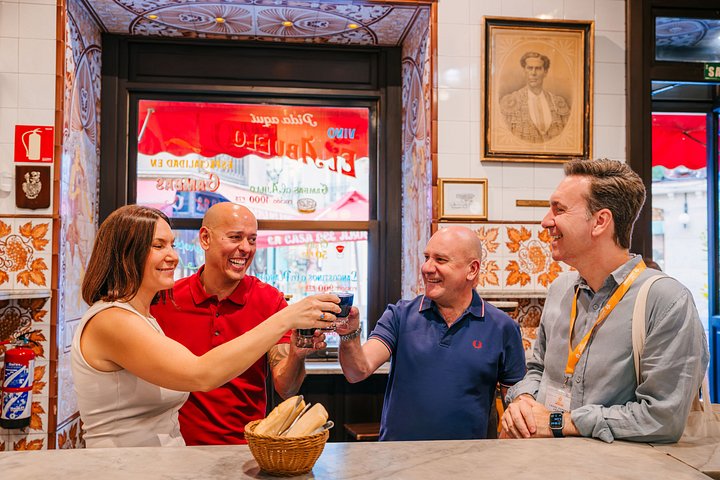
Transfer in private vehicle Mercedes V. The first part of the visit will be carried out with the vehicle, stopping at the viewpoint of the Valley, San Martín bridge, Alfonso VI gate and Puerta del Sol, speed and comfort so that no detail is lost. From the Plaza de Zocodover, the private route on foot will begin, in which we will visit the Primada Cathedral, San Román church, the Jewish quarter, Samuel ha-Leví synagogue and the exterior of the San Juan de los Reyes Monastery. The route is customizable. If you wish, we can take a break for breakfast churros con chocolate or have some tapas during the tour, in addition the group will have free time to walk, have lunch and shop. We offer you the possibility of booking a restaurant, to which we can transfer you with the vehicle if you need it. We can visit a sword and damascene workshop. Languages: Spanish or English. Return at 4:00 p.m. The price of this tour is another of its attractions, up to 7 passengers, offer until 12/31/21.
含まれるもの
料金に含まれるもの
- Entrance to the Church of San Román.
- Visit by vehicle and on foot with an Official Tourism Guide in Toledo in Spanish or English.
- Transfer from Madrid to Toledo and return in a private vehicle with an Official Tourism Guide.
- Exterior visit to the Monastery of San Juan de los Reyes.
含まれないもの
- Lunch
- Admission to Toledo Cathedral. 12,00 €/pax
- Admission to the Monastery of San Juan de los Reyes (4.00 €/pax)
行程
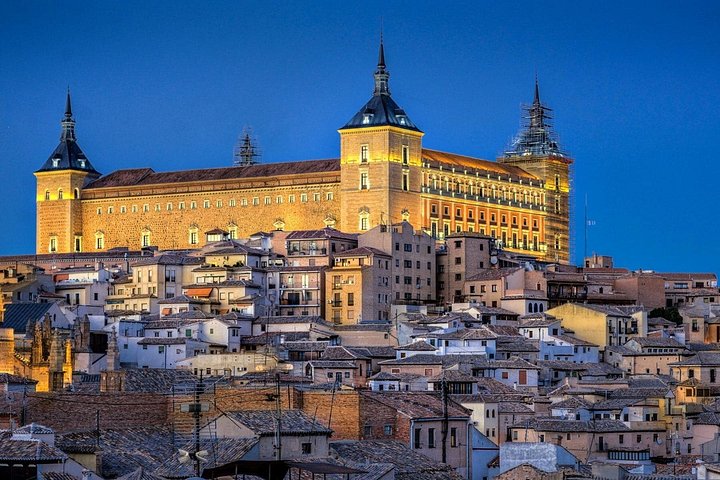
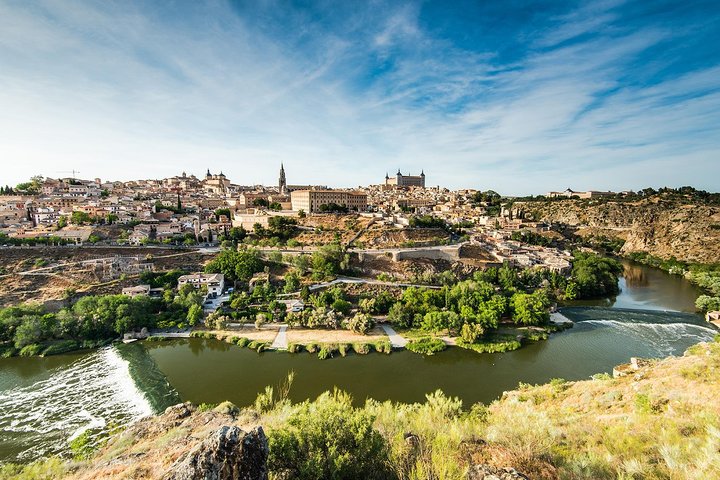
Magnificent panoramic view of the city, from which the importance of this strategic enclave is understood, formed on a hill surrounded by the Tagus River, in the center of the Iberian Peninsula. From the viewpoint, we can enjoy the skyline dominated by the Alcázar and the Gothic Cathedral, also the Baroque church dedicated to San Ildefonso. Also noteworthy is the Castillo San Servando and the military academy, and of course the entire Toledo hamlet covering the rock in which the various bell towers of the many parish churches that emerge throughout the city stand out. Of interest are also the archaeological remains around the river of Arab baths or the industry and crafts of a glorious past.
With the vehicle we will go to the medieval bridge of the fourteenth century, settled on five arches and formed between two defensive towers on impressive doors that give access to the Jewish quarter. The perspective from here to the Jewish quarter built on the rocky cliffs is wonderful.
Example of Spanish-Muslim military architecture from the 10th century. Built in the second walled area to protect the suburbs. It was until the 16th century the main entrance to the city. The name it receives is due to the fact that it was through it that the Castilian King Alfonso VI, accompanied by the Cid Campeador, entered on May 6, 1085 to take the city from Islamic hands. Preserve the elements of defense, including a forward keep and a parade ground.
Door that was originally a bastion tower attached to the Roman wall. It is the most Toledo of all the doors, in it we can differentiate the imprint of the different cultures that have dominated the city. Its entrance is made through a great horseshoe arch from the Caliphate era that is supported by columns and Roman ashlars. Its last reform corresponds to the fourteenth century in Mudejar style. It was the access to the Islamic medina, a space where the residential, commercial and religious areas were located.
The private walking tour will begin here. The nerve center of the city. It dates from the Andalusian medieval period, a moment that began to be dedicated to the commercial function, a function that has remained over time. With the Christian conquest the public and festive function is present and here receptions, bulls and other festivals are celebrated. The current configuration attends to a 16th century reform, when by order of King Felipe II, an attempt was made to homogenize the Castilian squares with balconies and arcades, surrounding its perimeter with taverns, inns and inns, a function that continues to be preserved today, with its current restaurants, bars and hotels, since then the busy atmosphere of the Plaza de Zocodover has been configured.
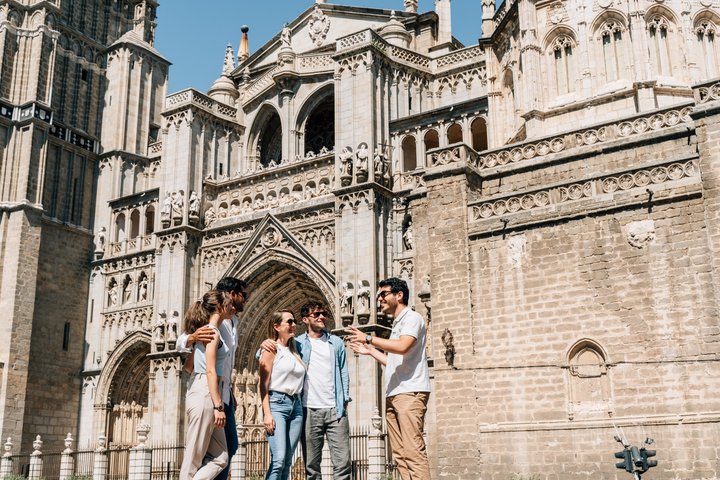
This visit is one of the most surprising and enriching experiences that we will live in Toledo. Stopping in each of its corners, interpreting them and seeing how art evolves through faith. Consecrated to the Virgin Mary in her Assumption to heaven, in a Gothic style with a clear French influence, its construction began in 1226, with Ferdinand III as King of Castile. It was finally finished in 1493 under the reign of the Catholic kings. During the visit, we will surround its perimeter, stopping at its doors, towers, and main facade. Inside we will take a tour of the main spaces and Museums: Chapel of the Descent, Custody, Cloister, Chapel of S. Blas, Main Chapel, Choir, Crypt, Sacristy where we will enjoy the spectacular art gallery with the Expolio and Apostolate of El Greco, works by Goya, Velazquez, Tiziano ... we will pass through the Chapel of the New Kings, Chapter House and we will end up at the Transparente, a culmination of the Spanish Baroque.
Wonderful example of Toledo Mudejar from the 12th century. Decorate its interior walls with Romanesque fresco paintings. It is the seat of the Museum of the Visigoth Councils. It is a perfect support to understand the history of the Middle Ages in Toledo, since it summarizes like no other space the mixture and the superposition of cultures that inhabited the city.
The first Jewish community arrived in these lands in Roman times, and little by little they will grow in number and influence, until they form a large neighborhood in population that will have ten synagogues and five rabbinical study centers. It was the most influential Jewish quarter in Sefarad (Hebrew name for the Iberian Peninsula). Today many remains are preserved, including valuable archeology, mikves, two splendid synagogues, one of them dates from the 12th century, the oldest in Europe and the other from the 14th century. Access to the well of El Salvador.
Built in the 14th century by Samuel ha-Leví, treasurer of King Pedro I of Castile, it is currently the Museum of Sephardic Culture. It has an impressive prayer room, women's gallery and museum where we can learn about the religious and cultural traditions, the daily life of the Jews throughout their history, also their origin, diasporas, arrival in Roman Hispania and expulsion from Europe. in 1492.
It was ordered to be built by the Catholic Monarchs, as a thanksgiving for the victory of the battle of Toro in 1476, which gave the throne to Isabel I of Castile. In a particular and characteristic Gothic style arrived from Flanders and developed in Castile, it forms a precious architectural example, where its excellent church and luxurious cloister stand out. Exterior visit.
キャンセル
開始24時間前まで無料でキャンセルでき、全額返金されます。
口コミ
5.0
- 51
- 40
- 30
- 20
- 10
評価は予約パートナーが集めた1件の口コミによるものです。旅行者自身の言葉を書かれた順に掲載しており、体験をよく見せるために並べ替えることはありません。
参加前に知っておくこと
- 送迎
- 送迎は全員に含まれます。
- チケットの種類
- Mobile or paper ticket accepted
- 催行会社
- Cuatro Calles - Viajes Creativos
- Wheelchair accessible
- Infants and small children can ride in a pram or stroller
- Service animals allowed
- Public transportation options are available nearby
- All areas and surfaces are wheelchair accessible
- Suitable for all physical fitness levels
How it compares in マドリード
- Its from-price is 98% above the median of the 287 日帰りツアー we list in マドリード.
- Its length is typical for the group.
- By number of reviews it ranks 185 of 287.
- The operator lists free cancellation on it.
About マドリード
マドリードはスペインの太陽の降り注ぐ社交的な首都で、一流の美術館、王宮、緑豊かな公園、真夜中まで賑わうタパスバーが待っています。
プラド通りには三つの大美術館が並びます。ベラスケスとゴヤのプラド美術館、ピカソの「ゲルニカ」を所蔵するソフィア王妃芸術センター、幅広い個人コレクションを誇るティッセン=ボルネミッサ美術館です。隣にはレティーロ公園があり、ボート遊びのできる池、木陰の並木道、ガラス張りのクリスタル宮殿があります。
Top-ranked sights in マドリード: Plaza Mayor, Royal Palace of Madrid (Palacio Real de Madrid), Puerta del Sol.
マドリードの特別価格
割引前と割引後の価格は事業者が示すもので、当サイトが付けたものではありません。